Why Marketers Should Know What a Vector Database Is

Storyblok is the first headless CMS that works for developers & marketers alike.
Most of us have learned a strange skill over the years: how to talk like a search engine. If you wanted to find something online, you didn’t just type your actual question into Google — you strategized. You shortened your query, trimmed away natural language, added quotation marks, removed filler words, and guessed which phrasing a machine might understand. You’d think, “Why does my laptop sound like it’s preparing for takeoff every time I open Chrome?” — but what you’d actually type into the search field would be something like: “laptop fan loud chrome fix.”
And it worked well enough. Keyword-driven search was fast, predictable, and built on systems designed to match text to text. As long as your query looked the way the system expected, you’d usually get something useful back.
But with the rise of AI tools, the way people search is changing. When you open ChatGPT or any AI assistant, you don’t think twice about phrasing your question naturally. You write the way you speak. You expect it to understand nuance, context, and intent — even if you can’t name a single keyword related to what you’re asking.
So how did we get here? How did we go from “speaking in keywords” to simply asking questions the way we would ask another person?
For marketers, this shift isn’t just interesting — it’s strategic. Because when search behavior changes, discoverability changes with it. And that means understanding why AI search finds some content and ignores other content — without turning marketers into engineers.
The answer sits behind how AI search works. Modern AI tools retrieve and understand information in a completely different way than traditional search systems — and that difference starts with how the data itself is stored and represented.
At the center of that shift is a new kind of infrastructure: vector databases.
If you’ve ever wondered how AI tools manage to surface the right answer (even when your question is messy, vague, or extremely human), you’re in the right place. Let’s pull back the curtain.
Why traditional systems struggle with AI-style search
Before AI search, most systems were built to handle structured, literal information: rows, columns, IDs, tags. This worked well for storing things like customer records, campaign data, or asset metadata.
What they weren’t designed for was meaning.
The moment you try to search by intent — “content that feels like this,” “assets with a similar tone,” “articles that answer this question even if phrased differently” — those systems fall apart. They don’t understand nuance, context, or concepts. They only understand labels.
That disconnect — often called the semantic gap — is the reason AI search feels so different from the search tools we’ve used for decades. And it’s also why marketing teams are starting to notice a new problem: great content that exists, but isn’t discoverable by AI systems.
If you’re curious about the technical reasons behind this gap, we cover them in detail here: What’s the big deal with vector databases?
The infrastructure shift behind AI search (in plain terms)
AI search doesn’t work by matching words. It works by matching meaning.
To do that, modern AI systems rely on vector databases — infrastructure designed to store and retrieve information based on semantic similarity rather than exact text. This is what allows AI tools to surface relevant answers even when queries are vague, conversational, or don’t include the “right” keywords.
You don’t need to understand how vector embeddings are generated or indexed to understand the impact. What matters is this: AI can only use content it can retrieve by meaning. If your content isn’t structured in a way AI systems can interpret semantically, it may never surface — even if it’s accurate, well-written, and valuable.
What this changes for AI search — and for marketing strategy
When search is based on meaning instead of keywords, visibility works differently.
AI systems don’t scan your site and decide which page deserves to rank. They retrieve pieces of information — explanations, definitions, examples — that best answer a question. Often, the user never sees the original page at all. They only see the answer.
This creates a new kind of discoverability gap. Not between page one and page two, but between content that AI can use and content it can’t.
For marketing teams, that gap shows up in subtle but increasingly important ways:
- High-quality content that never surfaces in AI-generated answers
- Brand messaging that gets summarized incorrectly — or pulled from competitors instead
- On-site search and chatbot experiences that feel brittle or keyword-dependent
- Content teams publishing more, but seeing diminishing returns on impact
In AI search, being “optimized” is no longer enough. Content has to be interpretable, context-rich, and structured for retrieval.
From keywords to knowledge
For years, content strategy revolved around individual pages and target keywords. In AI search, what matters is whether your content collectively answers the kinds of questions people actually ask.
That means shifting from:
- isolated pages to connected knowledge
- keyword coverage to topic coverage
- ranking signals to semantic clarity
Instead of asking, “Which keywords should this page rank for?” the more useful question becomes:
“Would an AI system understand this content well enough to use it as an answer?”
That’s the strategic shift behind vector-based search — even if marketers never interact with the technology directly.
Why this matters now
AI assistants are already becoming the first stop for research, troubleshooting, and decision-making. As that behavior scales, marketing visibility increasingly happens inside answers, not just on pages.
The brands that adapt early will shape how their products, ideas, and expertise are explained by AI systems. They’ll make their content reusable across search, chat, and internal tools without having to rewrite everything from scratch.
The ones that don’t risk becoming invisible. Not because their content isn’t good, but because it isn’t retrievable.
Vector databases in AI Search (RAG)
So far, we’ve looked at how vector databases store meaning and retrieve semantically similar content. RAG — Retrieval-Augmented Generation — is the framework that puts all of that to work inside modern AI systems.
RAG does two things at once:
- retrieves the most relevant information using a vector database, and
- generates a natural-language answer using an LLM.
RAG is the bridge between your data and the model’s reasoning. You don’t need to implement this yourself to understand why it matters, but it helps to see the flow at a high level. Here's how it works:
- Chunk your content
- Turn each chunk into an embedding
- Store all those vectors in a vector database
- A user asks a question
- The vector database retrieves the closest-meaning chunks
- The LLM uses those retrieved chunks to generate an answer
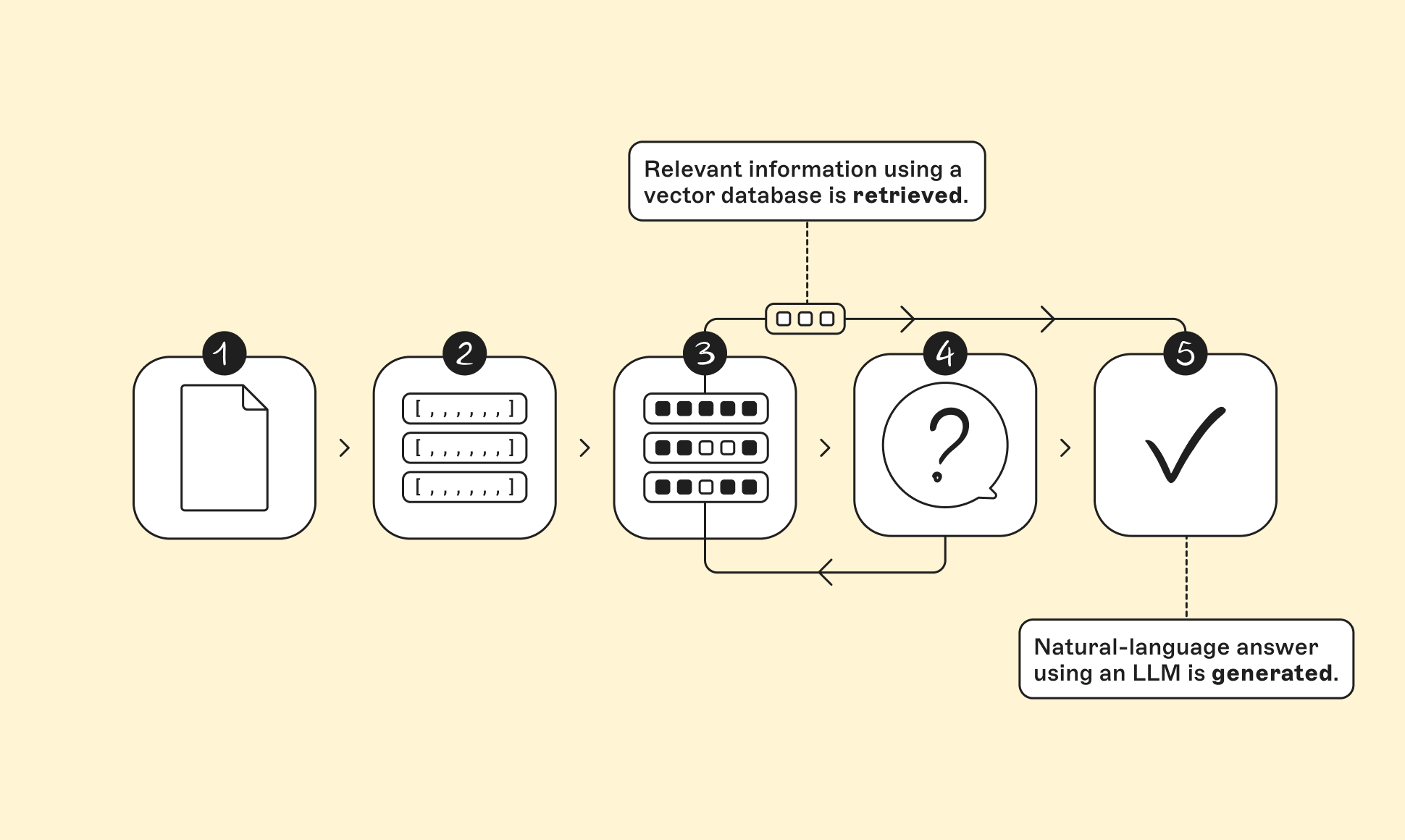
Together, these steps turn your content into a searchable, interpretable knowledge layer that an AI model can reliably draw from — instead of guessing or hallucinating.
Why this matters for marketers and SEO teams
- Marketers can build AI tools that pull accurate answers from brand assets, product descriptions, competitor research, and campaign data.
- SEO managers can create semantic site search experiences that understand intent instead of relying on limited keyword matches.
In other words: RAG gives AI access to your current information — and vector databases make that retrieval super fast and much more accurate.
What vector databases enable
Once you have a system that stores information by meaning instead of literal text, an entirely new world of capabilities opens up. Vector databases sit at the center of many AI-powered tools you’re already using — and many more that marketers, SEO managers, and developers are starting to build.
Here’s what they make possible:
1. Semantic search that feels intuitive
Instead of relying on exact keywords, vector databases return results based on the concepts behind the query. Ask “show me templates for chaotic project timelines,” and you’ll surface content that captures the idea — not just the words — especially when combined with traditional keyword search.
2. AI chatbots that actually “know” your content
When paired with RAG, vector databases let an AI assistant pull relevant information from your docs, knowledge base, product pages, blog posts, support tickets — anything. The result: chatbots that answer questions accurately using your data, not hallucinations.
3. “Find more like this” for creative and content teams
Whether it’s brand assets, ad creatives, blog posts, or user-generated content, vector search can surface items with similar tone, structure, style, or “energy.” This is massively valuable for audits, repurposing, and scaling creative production.
4. Smart recommendations
Because embeddings cluster similar items together, vector databases power recommendation systems that go well beyond “people who clicked X also clicked Y.” They can detect conceptual similarity, not just user behavior patterns.
5. Deduplication, clustering, and organization at scale
When millions of assets, documents, or datasets live in your system, vector databases can automatically group things by meaning and even flag near-duplicates — without relying on filenames or metadata.
6. Cross-media search
Text-to-image search, audio-to-text search, video-to-image similarity — these become possible when different formats are encoded into vectors that share the same space. That shared space is what enables truly multimodal AI experiences.
7. Enterprise search that understands intent
Across product docs, internal tools, repositories, assets, customer communications — vector search makes enterprise knowledge actually discoverable. Intent becomes the search input, not keywords.
How Storyblok's Strata fits into this picture
Strata brings vector-based content intelligence directly into Storyblok. Through its Semantic Search API, it lets teams search by meaning — not exact words — which makes it easy to surface the right content instantly, even when phrasing differs.
This vector layer can power smarter on-site search, more accurate chatbots, better recommendations, and AI-driven personalization. When someone asks, “Show me 2024 product updates for enterprise customers,” Strata can return feature releases, case studies, and related articles — not just exact keyword matches.
Because Strata works with Storyblok-approved, structured content, responses stay grounded, on-brand, and context-aware. It also automates tagging, keeps content accessible and compliant, and helps external AI tools retrieve verified, semantically rich information.
In short, Strata is a new AI-powered intelligence layer for your content — one that unlocks smarter search, richer context, and seamless integration with any AI model or workflow.


