The State of AI Readiness in Content Marketing: Early Industry Insights

Storyblok is the first headless CMS that works for developers & marketers alike.
No matter what industry you’re a part of, the size of your team, or the resources available, content teams everywhere are feeling the pressure of AI. To understand it. To implement it. But most of all, to deliver measurable results with it.
But the reality is messy. Countless tools, competing approaches, and bold claims about “what’s next” create a lot of noise around AI mastery with no single, proven roadmap to follow. Figuring out where to start, what to fix, and how to scale with confidence can be overwhelming — especially when we want to add genuine value to our teams and output, rather than simply checking the AI adoption box.
That’s why we built the AI Readiness Assessment: a comprehensive evaluation of AI adoption and implementation in content marketing. By assessing how teams are using AI across seven core content marketing functions, it provides a clear picture of readiness, a unique AI readiness score, and actionable guidance on where AI can drive the most impact — all in less than 15 minutes.
This article shares early insights from our global assessment results, showing how content marketing teams are performing across industries and regions. See where content teams are succeeding, where gaps remain, and get a clear sense of where your team might fall on the AI readiness spectrum — a crucial first step before deciding how to scale or optimize your AI strategy.
Before we dive in, let’s define our terms. AI readiness in the context of content marketing is the degree to which an individual, team, or organization can strategically, operationally, and responsibly integrate AI into their content workflows to produce genuine, measurable business value.
A framework for AI readiness: How do you compare?
Our proprietary AI readiness model evaluates content marketing teams across five stages, ranging from early AI exploration to advanced adoption and usage.
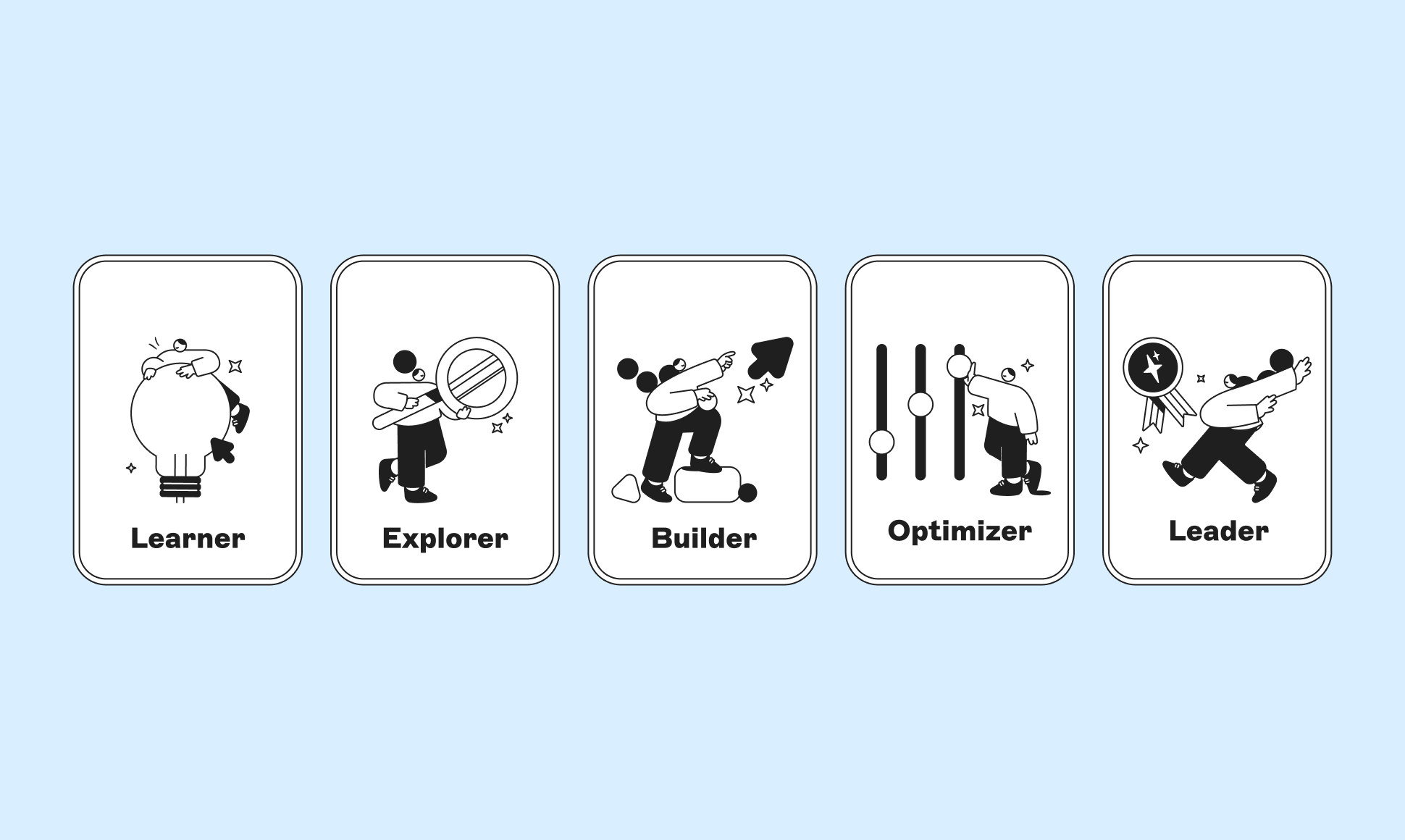
These stages reflect the extent of meaningful AI integration across seven core content marketing functions, including content strategy and planning, content creation, content structuring and optimization, distribution and publishing, performance and analysis, process and governance, and overall ecosystem integration.
Here’s a look at what each of the stages means:
- Learner: AI is on the radar, but your team is still a beginner with little to no AI embedded into everyday workflows or strategy.
- Explorer: You’re using AI here and there to speed things up, but it’s not consistent or dependable enough to drive real results at scale yet.
- Builder: AI is part of your day-to-day and helping you move faster, though processes and structure still need tightening to scale what’s working.
- Optimizer: AI reliably supports how you plan, create, and deliver content — now it’s time to lead what’s next in AI-optimized content operations.
- Leader: AI is baked into how your team works as a strategic asset, letting you scale content, adapt quickly, and stay ahead.
Now that you’ve got the context you need, let’s look at how global content marketing teams are performing in our new AI-driven world.
Crunching the numbers on AI readiness in content teams
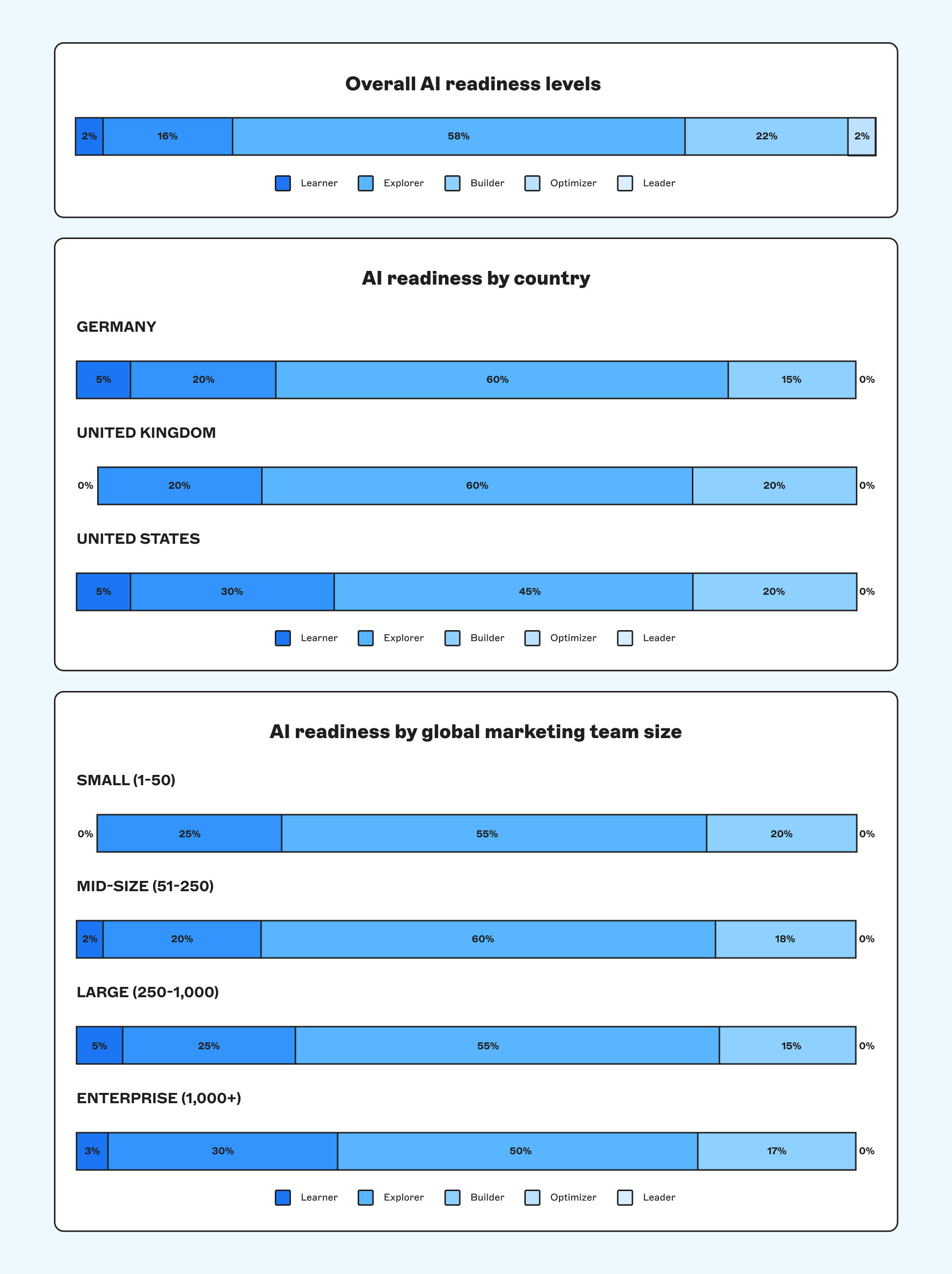
What the data is telling us so far
- The majority of teams are building their AI maturity: Over half of all content teams are actively using AI in day-to-day workflows, but many still lack fully structured processes to scale effectively and gain a real competitive advantage.
- Advanced AI implementation is rare: Only a small fraction of teams reach the “Optimizer” or “Leader” stages, indicating that embedding AI as a strategic asset remains a significant challenge.
- Team size matters, but it’s not everything: Larger teams aren’t necessarily further along in AI adoption; some small or mid-sized teams are outperforming larger organizations by integrating AI thoughtfully and consistently.
- Geographic differences exist: Adoption patterns vary across regions, with some markets showing higher experimentation rates while others are steadily progressing toward optimization. But overall, global content teams are still figuring it out with no region in particular powering ahead.
In short, while AI adoption is widespread, there’s still a gap between using AI tools and realizing their full, measurable impact. Teams are actively experimenting, building, and learning — laying the groundwork for AI to become a true enabler of strategy and results in the near future. But how exactly do we do that?
How do we reach the next level of AI optimization in content?
The first step to getting AI adoption right is knowing where you stand today so you know what to improve. Taking the AI Readiness Assessment gives your team a clear picture of how AI-ready your content operations really are today and where you can make some improvements that will actually matter for your team.
We’re building the plane while flying it. The biggest lesson so far is that the tool itself never determines success. What matters is understanding the real problem you’re trying to solve. Without that clarity, even the most advanced AI becomes nothing more than a collection of shiny buttons and demos.

Based on our data, most teams fall into the Builder stage of AI readiness: they have AI tools in place, but now need to build the structures — processes, governance, and workflows — to support them effectively. With this in mind, here are three top tips for teams that find themselves at the same stage:
- Document what works: Turn your best prompts, workflows, and results into simple playbooks to create consistency in your team.
- Invest in training and enablement: Strengthen AI literacy so teams understand not just how to use AI, but why and when.
- Strengthen composable content models: AI search is here to stay, and you need to build content that can be found, understood, and used by large language models (LLMs). To do this, expand your use of structured, reusable content blocks to support improved AI discoverability (and omnichannel delivery).
To dive deeper into how to improve AI readiness across seven core content marketing functions in the AI Readiness Assessment, download our How to Improve AI Readiness whitepaper, which breaks down how to go from Learner to Leader at every stage of the content marketing workflow.
-
In the early days we had to copy-paste information between systems to work with AI. That was a massive overhead and a broken workflow. Now that all is integrated through technology, it feels seamless and adoption has spiked. We also learned that the best tooling to use is, where AI is part of the product and not just a feature on top.

The road to true AI readiness
AI readiness isn’t just a nice-to-have — it’s an increasingly important factor in how effectively content teams can plan, create, and deliver value in an AI-driven landscape. The data shows that while most teams are experimenting and building their AI-optimized workflows, few have fully embedded AI as a strategic enabler, which means there’s plenty of work to be done.
AI readiness isn’t about having the newest tools in place. It’s about having processes that are clean, consistent, and structured enough that AI can scale them without scaling the underlying chaos. If you automate a broken workflow, you don’t fix the problem — you simply produce low‑quality outcomes faster.
By assessing your AI readiness, identifying achievable gaps, and taking deliberate steps to strengthen workflows, governance, and content practices, teams can move from early experimentation to meaningful implementation and ultimately to fully AI-optimized workflows tailored to their needs. This isn’t about chasing the latest hype — it’s about using AI where it truly adds value: accelerating content creation, improving quality, reducing repetitive work, and enabling teams to deliver more, faster, and smarter. Done right, AI becomes a tool to streamline operations, amplify creativity, and keep your team competitive and visible.