The Inside Story: How We Cut Our Content Debt by 12% — and Built a System To Keep It That Way

Storyblok is the first headless CMS that works for developers & marketers alike.
If you work in marketing, content auditing is probably one of those tasks that lives permanently on your to-do list, potentially dropping further and further down as new projects spring up. And even as a business obsessed with giving our customers the best content management system on the market, we had our own content audit on the back burner, too.
The problem with content debt is that tackling it means going backward: coordinating across teams, making tough calls about ownership and removals, and doing slow, unglamorous work while urgent requests pile up around you. So it waits — but the symptoms don't, and ours became impossible to ignore.
We had a list of problems that needed our attention: Search rankings that could be stronger for priority pages, old content resurfacing in AI search that didn’t reflect our current positioning, and pages that had long outlived their purpose still living on our site because nobody had gotten around to dealing with them.
This is the story of Operation Content Debt: a structured, cross-functional content initiative we built to fix our content debt — and we documented it every step of the way. In this case study we’ll uncover the problem, the process, the results, and the system we built to make sure our content debt doesn't come back. Here’s a sneak peek at the results:
- 691 pages removed
- 15% faster indexing
- 12% reduction in total content volume
Houston, we have a content problem

The Storyblok marketing website had grown the way most marketing websites do: organically, urgently, and without a consistent process for updating or retiring content when it had served its purpose.
A campaign launches, new assets go live. Our product evolves, new pages are written. An event happens, more content follows. Teams evolve, roles change, and content ownership becomes murky. You know the story. Each content decision made sense in the moment — the problem is the accumulation of hundreds of good decisions that were never revisited or optimized for long-term value.
By the time we ran our audit, we were carrying:
- 4,546 stories in the CMS
- 4,302 published stories
- 201 active components in the blocks library
This content debt was driving up build times, cluttering the component library, and forcing anyone searching the site — a prospect, a customer, an AI agent, even our own sales team — to wade through material that should have been optimized or taken down long ago. The scale of the problem was part of why it had been left to sit there. When a task feels daunting and requires significant stakeholder coordination, it's easy to deprioritize — especially when it means looking back rather than charging forward.
The other reason content lingers longer than it should is that the search marketing landscape shifted faster than most teams could keep up with. Once users started moving to AI engines for discovery, the old playbook — build equity, grow domain authority, let content compound over time — stopped being the whole story. That model had worked for over a decade, and when you're already stretched thin, it’s understandable why so many teams prioritized creating new content over assessing old content.
What changed for Storyblok was our framing of the problem. We launched Operation Content Debt — a named, cross-functional initiative with defined phases, clear ownership, and leadership visibility to master content maintenance. That framing fuelled action: this wasn't an informal content tidy-up, it was a commitment to reducing content debt and maximizing content health for the long haul. And the team was fully on board.
In short, huge. Storyblok's own research with FT Longitude puts the global cost of unmanaged content at $4.63 trillion — growing by roughly $146,905 every second. Content debt doesn't just slow your team down — it undermines your SEO, brand trust, and AI search visibility. Read Content Debt vs. Content Health to understand the full cost and how it connects to your brand's content health.
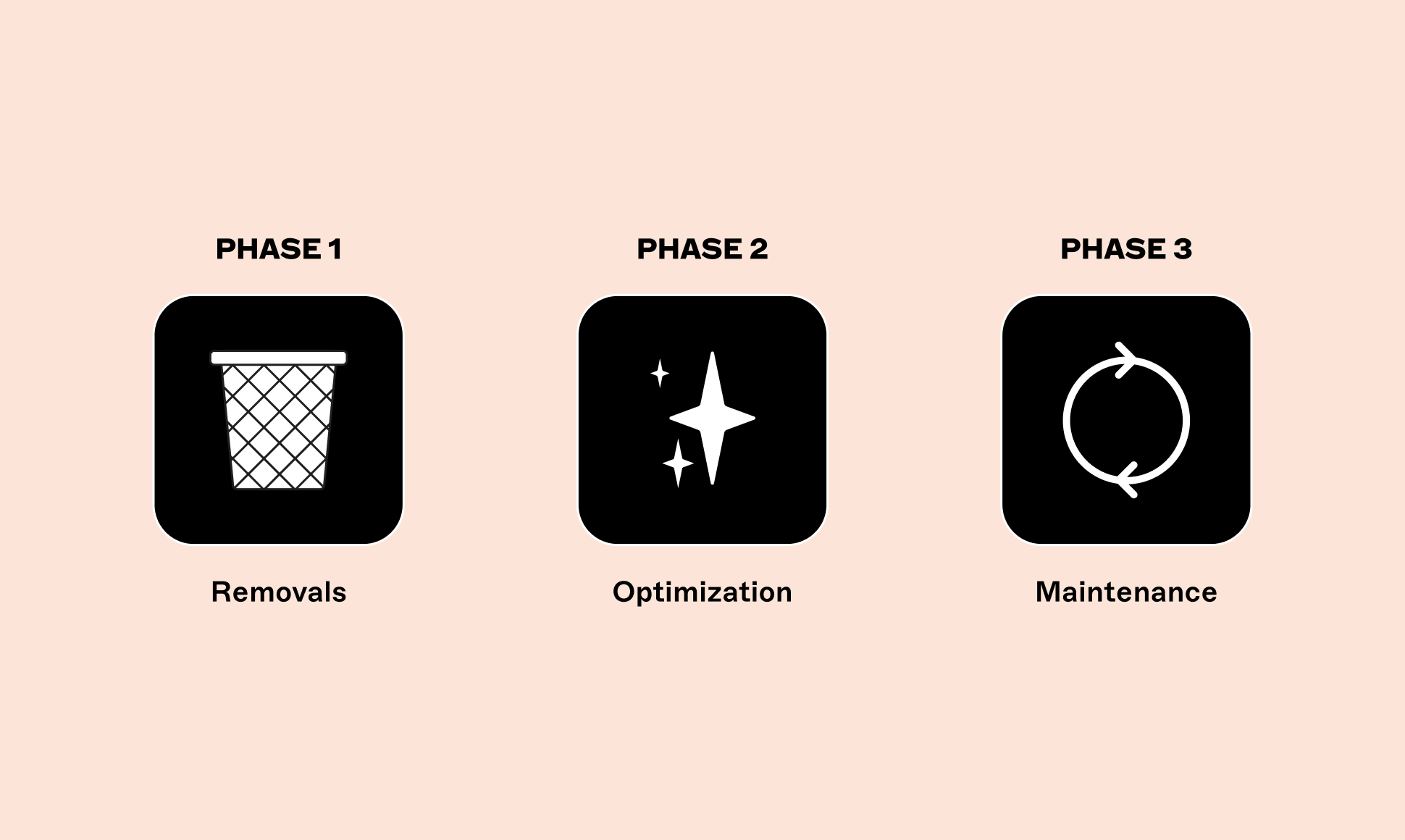
The operation was divided into three phases designed to build on each other:
- Phase 1— Removals: Our first priority was to identify and delete redundant and inaccurate content that wasn’t a candidate for optimization. No rewrites, no consolidation — just deletion.
- Phase 2 — Optimization: With the dead weight removed, we turned attention to content worth saving but underperforming. We consolidated duplicates into single authoritative pieces, refreshed what had aged, restructured what wasn't landing, and ensured current branding was applied everywhere.
- Phase 3 — Maintenance: The final phase was about making content health the default, not something we frantically return to every few years. That meant building the systems, review cycles, and ownership structures that catch debt before it accumulates — so the next audit is a routine check-up rather than an emergency operation.
Phasing the work wasn't just logistical, it was motivational. A clean, achievable scope for Phase 1 made it easy for teams to engage without feeling like they were signing up for an open-ended project. It also meant we could demonstrate value quickly, which sustained the momentum needed to carry through to the phases that followed.
You can’t conduct a successful audit without your development team if you want to preserve website performance. Before you kickstart any audit, consult your development team with your plan of action, and ask them to weigh in, raise any red flags, and confirm a project plan together.
Distributed ownership over centralized guesswork
As with many brand websites, content is owned and created by various teams across our organization. This meant that no central team could make informed decisions about every page across campaigns, partners, events, product, and beyond. The people closest to that content have to lead — they just need the right parameters to do it efficiently.
We built a master audit spreadsheet covering every page on the site, organized into tabs by team ownership. Each team reviewed their own pages and assigned one of three actions against each URL: Remove, Update, or Ready.
Each page was accompanied by traffic and engagement data — pageviews, time on page, and conversion signals where available — giving teams an objective baseline rather than gut feel or recency bias. A page with strong traffic but outdated information was an obvious candidate for an update. A page with near-zero traffic, no clear owner, and outdated content was an obvious removal.
This approach produced faster, more comprehensive decisions and stronger participation. Teams weren't being told what to delete — they were making the calls themselves, based on genuine knowledge of each page's purpose and what the data showed about its current value. The content team built the framework; owning teams made the final call.
Download our free content audit template, which provides the structure to scope the work, inventory every page, evaluate what stays and what goes, and build a clear prioritization roadmap.
Removing the psychological barrier to deleting content
One of the biggest obstacles to content auditing is the fear of regret. What if a deleted page is urgently needed three months from now?
We addressed it head-on: content deleted from the live site is moved to the CMS trash, where it remains fully recoverable at any time — without affecting site performance. That clarification mattered. When deletion feels reversible, people engage. When it feels permanent, they get cold feet. That single reassurance — “deletion is reversible” — was one of the most effective things we did to keep teams moving.
Phase one: 569 pages removed, immediate performance gains
The goal: Remove live and stored website pages that clearly delivered no value and were not suitable candidates for optimization or consolidation.
Every removed page was handled with technical precision: redirects added, custom 404 pages created for specific content types, and all page references reviewed and removed before each page was deleted. The web development team's work was crucial in ensuring there were no broken links, crawl errors, or orphaned references.
In phase one alone, across the organization, 569 pages were identified and removed. Revealing the biggest content debt contributors to be outdated events, webinars, and product announcement pages, which accounted for 71% of page removals and one of our biggest learnings (more on that in phase three).
Removing content doesn't mean removing our SEO strategy. The pages flagged for deletion were genuinely redundant — zero traffic, no backlinks, superseded, or outdated. High-quality, relevant content stays and gets stronger as the noise around it disappears. Topical authority comes from depth and coherence, not page count. Your search performance will thank you.
| Metric | Before | After | Impact |
|---|---|---|---|
| Total stories in CMS | 4,546 | 3,988 | ↓ 12% |
| Total published stories | 4,302 | 3,817 | ↓ 11% |
| Active block library components | 201 | 194 | ↓ 3.5% |
| Files in website deployment | 3,168 | 2,876 | ↓ 9% |
| Website deployment time | Up to 18 min | Up to 16 min | ↓ ~5% |
| Algolia index rebuild | 36 min 14 sec | 30 min 41 sec | ↓ 15% |
Reducing content debt cut our build times — but our web development team went further. Read this article to find out exactly what they did: How Concurrency Improvements Powered Storyblok's SSG Migration.
Phase two: 122 more removals, 101 targeted for optimization
The goal: Analyze remaining pages and identify which need to be updated based on accuracy, outdated branding, tone of voice, and performance.
With the obvious deletions done, Phase 2 introduced a harder question for the pages that remained: Are we confident that this content has earned its place?
For our team, earning its place means a page is performing, serving a clear audience need, or supporting a strategic goal. Pages that couldn't clear that bar didn't make it through — leading to an additional 122 pages removed, bringing the total across both phases to 691.
Beyond the removals, phase two led to:
- 101 pages identified for optimization from a product marketing, search, and conversion performance perspective — pages with genuine value that aren't yet reaching their potential.
- 15 high-priority pages flagged for optimization within the next 30 days, selected based on linking frequency, brand alignment, product relevance, traffic, and current performance.
Those 15 were the first priority because they were most likely to move the needle quicker. The remaining 86 are being built into team pipelines with clear ownership and timelines — so we don't lose momentum or slip back into old habits.
Phase three: Building a system for content health
Most content audit articles end at phase one or two. This is where ours gets interesting.
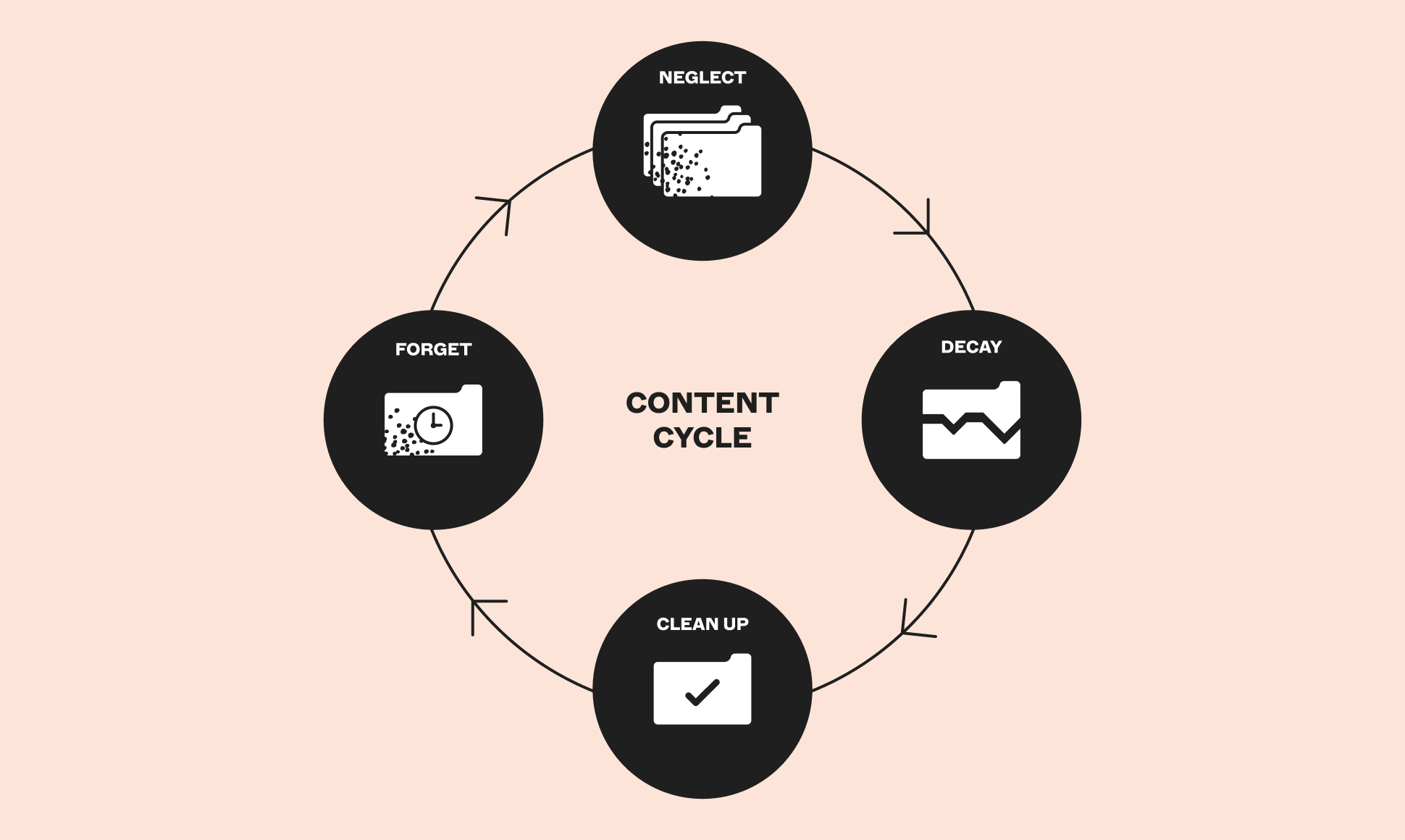
The catch with content health is that the clean-up is not the end of the work. Without a solid maintenance system, debt re-accumulates, and you find yourself in the same situation every couple of years.
The same dynamics that created the problem — a preference for creation over maintenance, the absence of clear ownership, a lack of scheduled reviews — will rear their ugly heads unless something actively disrupts them. Phase 3 was about engineering that disruption into the way our team and tech work.
Clear cross-team content ownership
Content debt thrives in the absence of ownership. When no one is clearly responsible for a page, no one notices when it goes stale, and when someone does notice, ambiguous ownership makes action difficult and slow.
The foundation of Phase 3 is a content ownership database: every page category on the site is assigned to a named individual — not just a team, a person — built in Notion and validated by each team. This database is reviewed every six months to ensure continued accuracy and accountability.
Content deprecation policy
Clear criteria detailing when content should be retired and removed from the Storyblok website was a top priority for managing content debt in the long term. We’d already done the legwork in Operation Content Debt to remove hundreds of redundant pages, now it’s about setting up a system to stop that from happening again.
For Storyblok, that means defined timelines by content type: global event pages and product feature pages retire one year after publication, field and partner events one week after event completion, and remaining pages are assessed on performance, relevancy, and accuracy through the new audit cadence we established as part of the initiative (more on that soon).
Automated maintenance and content triggers
With ownership and policy in place, the final structural piece was automation: removing the always-on background load of manually monitoring a large content estate. We built a trigger system that fires alerts when specific conditions are met, without anyone having to check. Here are a few we implemented:
- Event and product feature pages are automatically removed on a rolling schedule — one year after publication. Field and partner events are removed one week after the event.
- Blog articles alert if a year in the title no longer matches the current year, prompting an update and/or flag any article that has been unvisited for six months, prompting analysis from the owning team.
- Core pages alert the owning team if they haven't been updated in over a year, prompting teams to assess whether an update is required.
- General health signals cover the entire site: broken links, missing or duplicated metadata, and new pages with URLs or titles that closely match existing ones.
This trigger system remains agile, and we’ll continue to add and tweak triggers as we solidify the system that will allow us to maintain content health long-term.
Sustainable content audit cadence
With triggers handling the continuous monitoring, the formal audit cadence is for the work automation can't do: strategic analysis, gap identification, and qualitative judgment. The stuff that still needs a human touch.
| Cadence | Action |
|---|---|
| Quarterly | Owning teams work through any accumulated trigger notifications and plan the necessary actions for the next quarter. |
| Biannually | An AI and traditional search audit to identify gaps and optimization opportunities for the next six months. |
| Annually | A deeper strategic review — content map gaps and overlaps, competitor reference checks, and a review of the trigger system. |
| Event-driven | Product launches, rebrands, and major announcements trigger their own targeted audit, with cross-team ownership. |
The goal going forward: everyone creates with purpose and maintains by default — rather than cleaning up every few years because the debt has become impossible to ignore. Content health becomes part of every content-owning team's remit, creating shared responsibility and clear actions on a routine basis.
89% of B2B buyers reportedly use AI in their buying process. This means that AI search performance isn’t just a biannual audit task; it’s a daily priority for many marketing teams. This free AI-readiness assessment for content teams helps you find out where your team stands in the AI-driven content era.
Six lessons worth learning before your next content audit
- Name the initiative: A named, structured program gets prioritized. An informal tidy-up doesn't. Leadership visibility and a defined scope are what turn good intentions into completed work. You can also have a little fun with it to inspire your team to get involved.
- Ownership is critical: Clear ownership isn't about knowing who created a page — it's about having someone accountable when a problem is identified, or an update is due. Establishing clear, individual accountability — not team-level responsibility — determines whether content stays healthy after the audit ends.
- Ground decisions in data: Gut feel and recency bias are the enemies of a good audit. Traffic, engagement, and conversion data turn ambiguous calls into obvious ones and remove the politics from difficult decisions.
- Build content health into your system: A content audit with no maintenance plan is a temporary fix. The goal isn't a cleaner website today — it's a system that prevents the same problem from recurring in two years. Build for the next five audits, not just this one.
- Debt reduction compounds: Removing content shrinks the surface area of every other problem you're carrying — technical, operational, and strategic. The returns from a clean-up are consistently larger than they appear at first glance, making the business case stronger than most teams realize.
- Content health is a business risk, not a maintenance task: Outdated, bloated content estates suppress search rankings, dilute AI discoverability, and erode brand credibility. In a world where AI search is increasingly the first point of contact between your content and your audience, the cost of inaction is growing — and it's measurable.
The business case for dealing with content debt
The numbers from Operation Content Debt speak for themselves: 691 pages removed, 15% faster indexing, a cleaner site for every person — and every AI agent — that encounters it.
But the more important outcome isn't the numbers — it's the system. Uncontrolled content debt suppresses search rankings, weakens AI discoverability, erodes brand credibility, and creates compounding technical overhead. The longer it goes unaddressed, the more expensive it becomes to fix, and the more ground you cede to competitors who've already dealt with it.
For us, Operation Content Debt gave us the opportunity to take control of that risk and be back in the content driving seat, something that’s more important than ever in the era of AI. And we’ve already seen results from the page removals and optimizations we’ve done and the governance system we’ve built. We are far more confident in our content and in the systems that enable us to create, deliver, and maintain it — and that confidence is what allows us all to do better work and achieve greater results.
The key takeaway: Content debt is not a problem you solve once. With the right system, it becomes something you manage continuously rather than confront in a crisis. That's a fundamentally different position — and the one every marketing team should be building toward.