The MCP Server: Why Your Content Infrastructure Needs to Be Agent-Ready

Storyblok is the first headless CMS that works for developers & marketers alike.
There's a shift happening in how software gets built and operated. And the reality is that it's moving faster than most teams expected.
AI agents aren't a future concept anymore. They're already drafting content, querying APIs, running deployments, and orchestrating workflows across tools your team uses every day. The question isn't whether agents will touch your content layer. It's whether your content layer is ready for them when they do.
This is where the Model Context Protocol, and as a result our very own MCP Server, comes in.
What is the Model Context Protocol (MCP)?
MCP is an open standard developed by Anthropic that defines how AI agents communicate with external tools, APIs, and data sources. Think of it as a universal adapter between a language model and the systems it needs to interact with.
Before MCP, integrating an AI agent with a service like a CMS meant writing bespoke connectors, building custom function-calling schemas, and maintaining the glue code every time either side changed. MCP standardises that contract. An agent that speaks MCP can connect to any MCP-compatible server, without custom integration work on either end.
The protocol defines a structured interface where servers expose a set of named tools, each with a clear description and input schema. The agent decides which tools to call, in what order, and how to chain results together. The server executes the operation and returns structured output. That's it.
MCP is already supported by Claude (via Anthropic), Cursor, and a growing list of AI development tools. It's quickly becoming the de facto standard for agentic tooling. And that's exactly why Storyblok built a native MCP Server.
You want to learn more about modern the Storyblok MCP Server? Find out more information here!
What is the Storyblok MCP Server?
The Storyblok MCP Server is a production-ready MCP implementation that connects any MCP-compatible AI agent directly to Storyblok's content and management layer. It exposes various tools spanning the full breadth of what you can do with Storyblok. That includes anything from reading and writing content entries to managing spaces, components, assets and roles.
That means an agent running inside Claude, Cursor, or any other MCP-compatible runtime can:
- Fetch and filter content entries across spaces
- Create, update, or publish stories programmatically
- Manage component schemas and content models
- Query and manipulate assets, folders, and media
- Inspect and modify space configuration
The server doesn't wrap a subset of the API for demo purposes. It exposes the management layer comprehensively, so that agents can do real work, not toy examples.
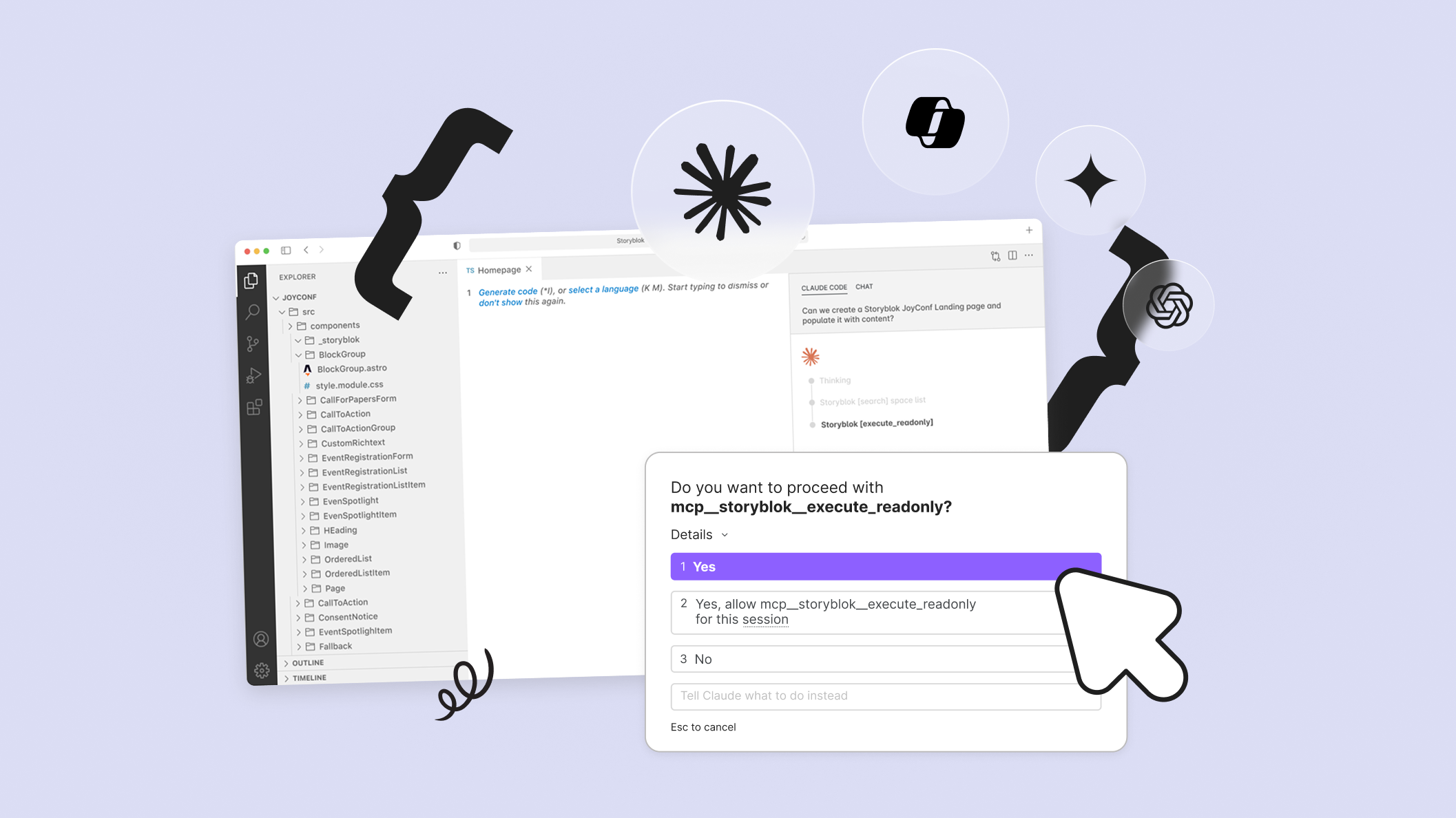
Storyblok MCP
How it works
The architecture is straightforward. When an agent receives a task, such as, "translate all English product descriptions into French and publish them", it reasons through the steps required and begins making tool calls against the MCP Server.
Each tool call is a structured request: a tool name, a set of typed input parameters, and an expected output shape. The MCP Server handles authentication, validates the request, calls the underlying Storyblok API, and returns structured JSON that the agent can reason over and pass into its next step.
The agent maintains context across multiple tool calls, building up a working state as it goes. It can paginate through large content sets, branch its logic based on what it finds, and handle errors gracefully. And it does all that without a human in the loop.
From a developer's perspective, setup is minimal. You point your MCP-compatible client at the server URL, provide your Storyblok credentials, and the full tool catalog becomes available to your agent immediately. No SDK to install, no OpenAPI spec to manually wire up, no custom function schemas to write.
Looking for a Practical Guide on how to use the Storyblok MCP? Find it here!
Why structured content is the foundation agentic AI needs
Not all content is equal from an agent's perspective. Unstructured content — long HTML blobs, legacy page builders, proprietary formats — is hard for agents to parse, modify, and reason over reliably. The agent has to do expensive interpretation work before it can do anything useful, and errors compound fast.
Storyblok's content model is different. Every story is composed of structured components with typed fields — strings, rich text, assets, references, arrays, booleans. That structure is queryable, predictable, and machine-readable by default.
This is what makes Storyblok a genuinely solid foundation for agentic workflows, rather than just an API the agent happens to be able to call. The content the agent receives is already in a form it can work with cleanly. It can navigate the component tree, identify the fields it needs to operate on, and write back structured output — with far less ambiguity and far fewer hallucination risks than unstructured alternatives.
Content health matters here too. Outdated, inconsistent, or missing content doesn't just create bad user experiences — it creates bad agent outputs. AI systems, including the LLMs powering your agents, and the retrieval systems behind AI-generated answers, are only as good as the content they have access to. Governed, up-to-date, structured content is the input quality floor for reliable agentic behaviour.
What this unlocks in practice
The most compelling agentic use cases aren't about replacing human editors. They're about eliminating the toil that slows teams down and scaling operations that were previously bottlenecked by headcount.
Multilingual content at scale. An agent can traverse every story in a space, identify untranslated fields, call a translation service, write localised content back into Storyblok's internationalisation layer, and flag entries for human review. And all of this in a single orchestrated run. What used to take a localisation team days can happen overnight.
Content auditing and remediation. Agents can inspect every published story against a defined quality criteria. They can check for missing SEO metadata, broken asset references, outdated component usage, or content that hasn't been touched in over a year. Rather than generating a report for humans to act on, the agent can resolve what it can and surface only the edge cases that need a human decision.
Dev-to-staging content migrations. Moving content between Storyblok environments is tedious and error-prone when done manually. An agent with access to both spaces can handle diffing, transformation, and migration, with a reliability that's hard to match manually — and even do it on a schedule or triggered by a deployment event.
Dynamic content generation for campaigns. Marketing teams can brief an agent with a campaign theme, target audience, and content model, and have it generate a set of draft stories ready for editorial review. The agent isn't the editor; it's the first draft machine that removes the blank-page problem.
Automated component governance. As Storyblok spaces grow, component proliferation becomes a real maintenance burden. Agents can audit component usage across spaces, identify deprecated schemas still in use, and help migrate content to updated component structures — which is exactly the kind of housekeeping that developers know needs doing but rarely have time allocated to it.
The window to get ahead is now
The teams that will have a structural advantage in the next 18 months aren't the ones that adopt the flashiest AI features. They're the ones that get their content infrastructure into a state that agents can actually work with. That means structured content models. Governed, well-maintained entries. An open, standardised interface that any agent can plug into.
Storyblok's MCP Server is the piece that connects your existing content investment to the agentic layer without a rebuild, without a migration, and without betting on a single AI vendor's ecosystem.