Digital Experience Platform vs Headless CMS: A Guide For Modern Teams

Storyblok is the first headless CMS that works for developers & marketers alike.
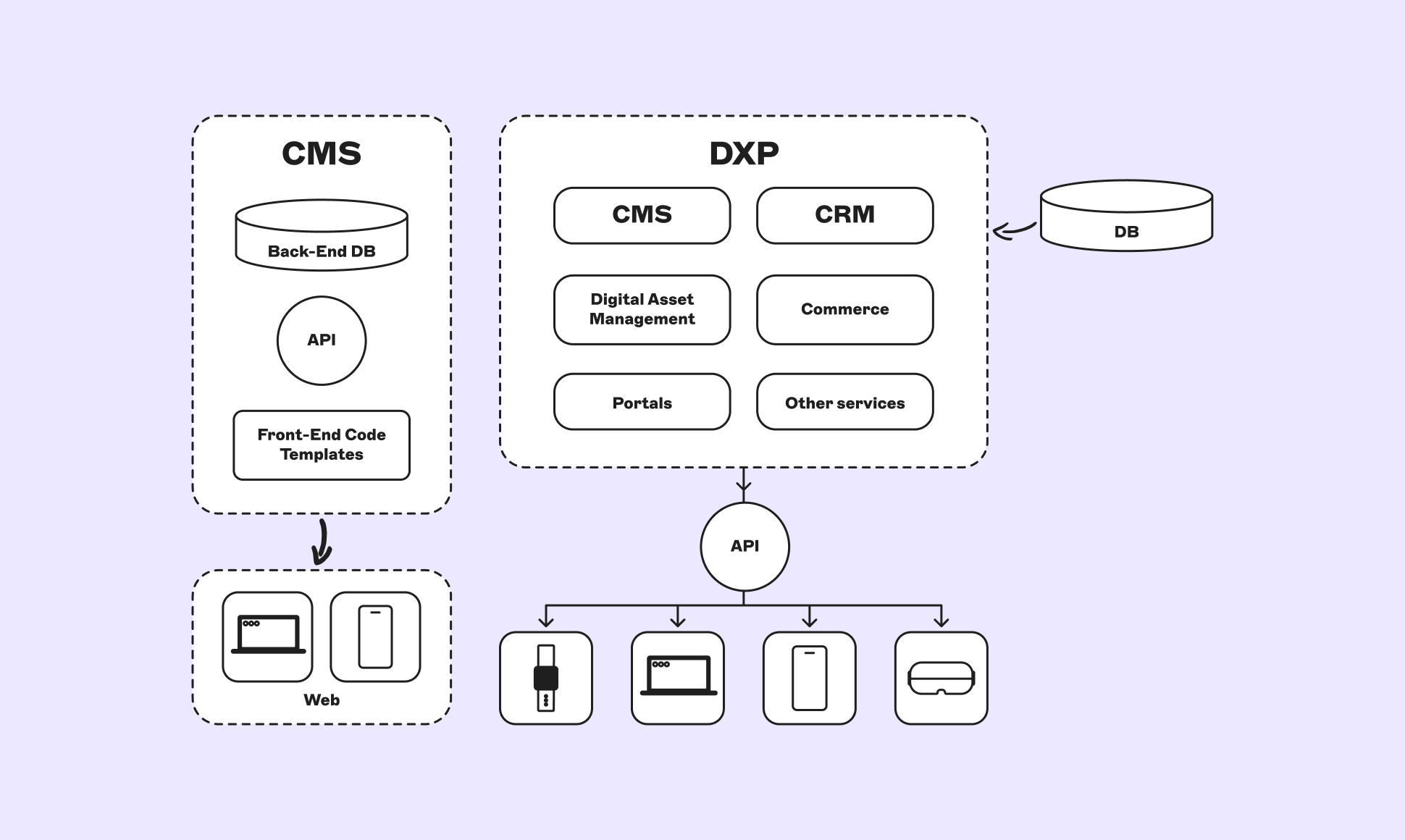
Every marketing and digital team faces the same challenge: figuring out how to deliver greater brand and customer experiences without unnecessary friction. Teams want to move faster, reach customers across multiple channels, and make their digital tools actually work together — yet the options out there can feel overwhelming.
Between CMSs (Content Management Systems), DXPs (Digital Experience Platforms), and all the other three-letter acronyms floating around, it’s easy to feel lost. Yet the truth is, most of us aren’t trying to chase the latest tool on the market — we’re trying to get our content out the door faster, keep it consistent, and deliver experiences that actually connect with our audiences. And we just want the right tech to help us achieve that.
When it comes to modern, omnichannel, high-quality content and digital experience delivery — a vital component of any marketing strategy today — teams want to know which platform will actually make their lives easier. This article aims to provide practical guidance to help in that quest as we break down what CMSs and DXPs do, how they differ, and which offers the most effective support for modern teams. Let’s get started!
What is a digital experience platform (DXP)?
Gartner defines a DXP as “a cohesive set of integrated technologies designed for the composition, management, delivery, and optimization of personalized digital experiences across multiple channels in the customer journey.”
Get an in-depth definition of digital experience platforms, what they offer, and the difference between suite and composable offerings in this article.
They emerged as a response to the troublesome patchwork of systems many teams had been using to manage their digital experiences before DXPs entered the market. The previous disconnected systems made it hard to deliver consistent, personalized experiences across channels. DXPs emerged to unify these capabilities, helping organizations manage content, data, and customer interactions from a single, integrated ecosystem.
Many offer a wide range of capabilities, including:
- Content creation and multi-channel delivery
- Inventory management
- Customer data and user profiles
- Personalization and targeting
- Analytics and performance tracking
- Journey orchestration across touchpoints
- Payment integration
DXPs are often marketed as an “all-in-one” solution for digital experience delivery, personalization, and optimization — a compelling promise for brands looking to meet today’s rising digital-native customer expectations. In reality, however, achieving that vision can be complex. While some DXPs are offered as single platforms, most are composed of multiple integrated tools working together toward a shared goal. Implementing and managing a DXP typically requires significant technical expertise, careful configuration, and ongoing maintenance to ensure everything works and scales seamlessly. A resource demand that can add significant strain in the long term.
The rise of composable DXPs: Seeking a modular future
One of the challenges with traditional DXPs is that many were built as rigid, monolithic suites. While powerful, these systems often struggled to integrate with modern tools or adapt to evolving business needs, making it difficult to do as they promised: deliver standout digital experiences quickly and efficiently.
This led to the introduction of composable DXPs, which aim to address this issue with a modular approach. Composable DXPs connect best-of-breed tools via APIs, allowing organizations and teams to build flexible, scalable digital ecosystems tailored to their specific needs and goals. Without the constraints, complexity, or delays often associated with the monolithic architecture of their traditional counterparts.
However, even with composable DXPs making it easier to add new tools, the sheer number of features and capabilities these platforms offer can sometimes create more complexity and cost than value. Another common drawback is feature bloat. Many organizations end up paying for tools and capabilities they rarely — or never — use, but can’t easily remove from the platform or their package. Something worth considering before diving into any Digital Experience Platform.
What is a content management system (CMS)?
At its core, a Content Management System (CMS) is software that enables users to create, edit, manage, and publish digital content — most commonly for websites — without needing extensive technical or coding knowledge. It serves as a central hub for all content, providing a structured way to organize, store, and deliver information to your audience efficiently.
Modern headless CMS platforms take it to the next level by enabling multi-channel delivery. Content can be published not only to websites, but also to mobile apps, social media, e-commerce platforms, IoT devices, and other emerging digital touchpoints — all from a single interface. This capability is critical for teams aiming to reach their audiences wherever they are today and wherever new channels emerge in the future. With the rise of AI-powered tools, chatbots, AR/VR experiences, and other innovative technologies, having a CMS that can seamlessly deliver consistent, high-quality content across every touchpoint is more essential than ever.
The two types of CMS: legacy and headless
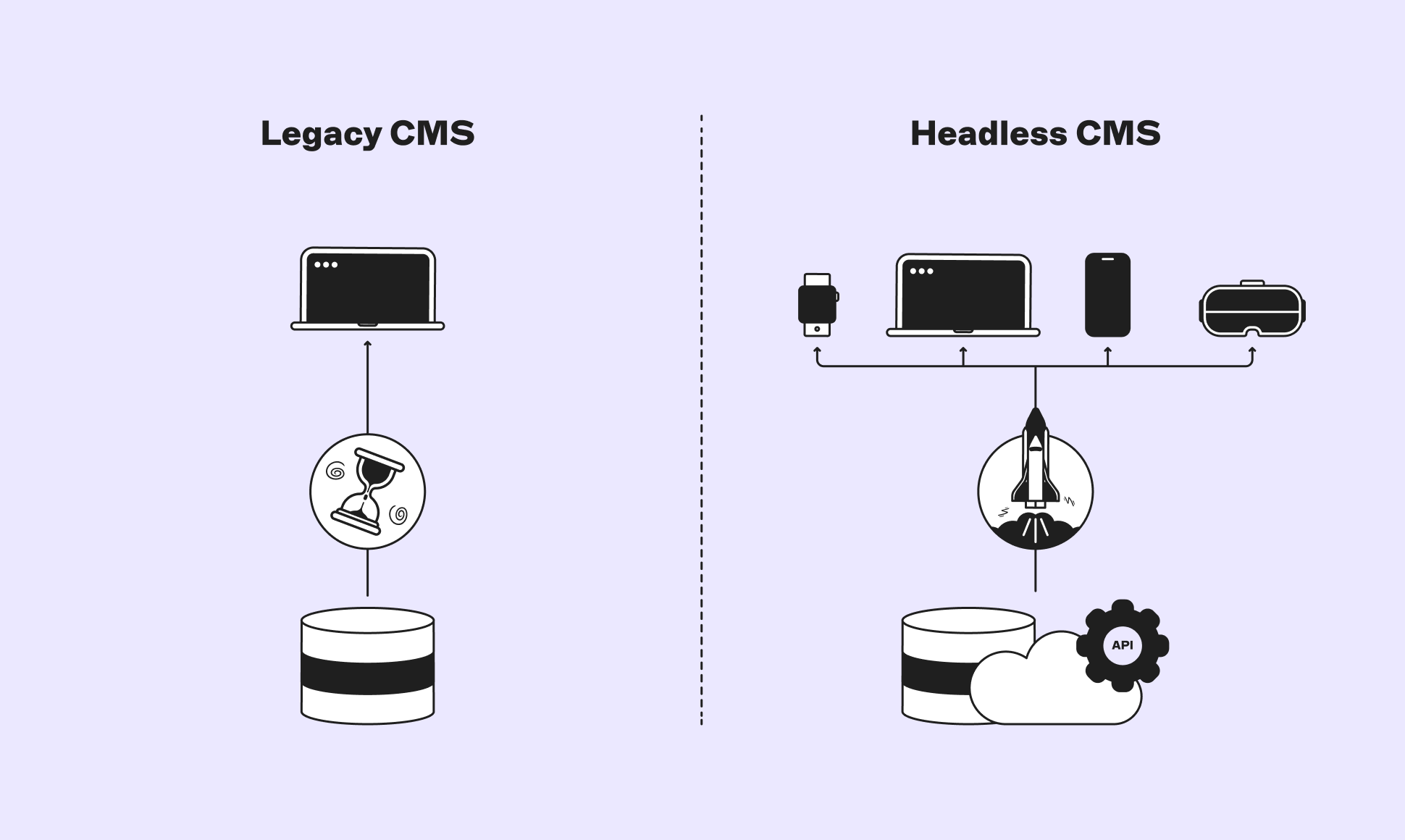
Legacy CMS and headless CMS share the same foundation, but they differ significantly in architecture, capabilities, and the benefits they offer.
What does a legacy CMS offer?
A legacy CMS — sometimes called a traditional or monolithic CMS — is a platform that couples content management and presentation in a single system. It provides a built-in front-end layer (i.e., templates or themes) alongside the backend, where content is created, stored, and managed. This tight coupling makes it relatively straightforward for developers to build and launch websites quickly, which is why legacy CMS platforms have long been a staple for businesses first establishing an online presence.
Legacy CMS solutions work better for small businesses and entrepreneurs, offering ease of use and functionality that removes many technical barriers. However, as content needs grow, these platforms can become bottlenecks. They often struggle with scalability, enterprise-level security, and performance demands, and their rigid architecture limits multi-channel delivery and integration with modern tools.
For larger organizations, these limitations make legacy CMS platforms less suitable, as the complexity and volume of content, features, and digital experiences required at scale exceed what traditional systems can efficiently handle. They’re also notoriously complicated for non-technical users when creating, updating, or publishing content, leading to overreliance on developers and bottlenecks in content delivery long-term.
What does a headless CMS offer?
A headless CMS decouples the content backend from the presentation layer, enabling content to be managed centrally and delivered via APIs to any frontend or digital channel. Unlike legacy CMS platforms, which are tightly coupled to templates and websites, headless CMS platforms are API-first, composable, and highly flexible, allowing content to flow seamlessly across any chosen digital channel.
Headless CMS platforms are ideal for organizations that need speed, customization, and adaptability. Developers can build modern frontends using any framework or technology stack they prefer, while marketers and content teams can manage and push content efficiently across multiple channels independently. They also integrate seamlessly with AI-powered tools, personalization engines, and other modern digital technologies, making them well-suited for enterprise businesses, large-scale projects, and teams looking to future-proof their content strategy and tech stack.
The benefits of headless at a glance
- Developer freedom and flexibility: Decoupled, API‑first architecture lets developers build frontends with any framework, swap them out as technology evolves, and connect seamlessly with third‑party tools and services. Future-proofing your tech stack without touching the content layer.
- Scalable architecture: Because backend and frontend are separate and delivered via APIs and CDNs, good headless CMS platforms can scale independently to support high traffic and global content distribution without performance loss.
- Built for security: API‑first and decoupled design reduces the attack surface compared to traditional platforms, isolates content services from public access, and supports robust authentication and access controls.
- Omnichannel content delivery: Manage structured content once and publish it anywhere, without rework.
- Marketing agility: Content creators can update and distribute content across channels quickly without dependency on developer ticket queues.
DXP vs headless CMS: What’s best for modern content delivery?
A headless CMS is designed to enable fast, flexible, and scalable content management and delivery. Its decoupled, API-first architecture allows teams to publish content across any channel from one central source of content truth.
Developers get the freedom to build high-performance frontends using the frameworks they choose, while marketers can manage content independently, personalize experiences, and launch campaigns quickly without waiting for developer support. This combination of flexibility, speed, and omnichannel readiness makes a headless CMS the ideal foundation for most modern teams.
A digital experience platform (DXP), on the other hand, is built to manage the full customer experience, combining content, data, analytics, personalization, journey orchestration, and sometimes e-commerce into one platform. While powerful, DXPs are often more complicated, costly, and resource-intensive to implement and maintain. For many organizations, DXPs can be overkill — offering capabilities that may not yet (or ever) be needed, and adding unnecessary complexity to workflows.
In practice, a headless CMS can often deliver the same benefits as a DXP at the content level, while keeping teams agile, reducing costs, and allowing organizations to integrate additional tools as they grow. Many modern DXPs are actually built on top of headless CMSs, reinforcing the idea that content-first, API-driven architectures are the smart starting point for future-proofing digital experiences.
Ultimately, the choice between the two depends on the scope and scale of your content operations. If your priority is to deliver flexible, fast, omnichannel content with developer freedom and marketing autonomy, a headless CMS is an ideal starting point. If your goal is to orchestrate complex, personalized experiences across multiple systems and channels at enterprise scale, a DXP may be the right solution — or better yet, the next evolution of a composable stack built on a headless CMS foundation.
Find out what it's really costing you. Check out The Cost of Doing Nothing: How Legacy Tech Dulls Your Competitive Edge | Sitecore Edition for a comparative deep dive.