AI Security: Why Your CMS Matters More Than Ever

Storyblok is the first headless CMS that works for developers & marketers alike.
- Learn more about GEO (opens in a new window) and what it means for your content
- Discover true enterprise-grade CMS security (opens in a new window)
With the increasing inclusion of AI in our lives, cybersecurity can feel like a minefield of risks. The good news is that AI hasn’t introduced a whole new category of threats. The bad news, however, is that AI has amplified all the old ones – including the age-old issue of brand reputation.
GEO and AI are increasingly overtaking traditional search, even for people who begin their user journey on traditional engines (opens in a new window) like Google. Your CMS is now the ultimate gatekeeper: generative AI can only work with trusted, high-quality inputs from your content management system.
Unfortunately, that also means any risk to your CMS puts your entire brand identity at risk. If content becomes outdated, compromised, ransomed, or deleted, your reputation will suffer – and in an increasingly fast-paced, tech-forward world, there’s no promise of recovery.
Let’s dive deeper into why your CMS is such an essential part of brand security in the age of AI and cover a few security standards to help you safeguard it.
The evolution of CMS: From repository to AI input layer
Content management systems started out simple enough: for many in the early years, it was more or less a place to simply store your content until you needed it. Publications were one-and-done, and optimization focused mostly on traffic and SEO.
Today, it’s expanded tenfold. CMSs are now the engine behind your entire brand identity. That means product info and marketing, of course, but it’s also a primary source that tells AI everything customers would need to know about your brand.
There’s no longer such a thing as one-and-done content. All content can now be surfaced by AI, meaning all content is now enterprise critical. Nothing is forgotten, and everything you put out can be picked up and shared by one of the most popular browsing methods around.
This increased visibility can be a valuable opportunity to reach even broader markets. But it’s also a challenge: one CMS error, one security breach that impacts your content, and your brand identity could take a major blow:
- Bad actors - internal or otherwise - sabotaging content to poison AI outputs
- Well-intentioned but unauthorized content changes being accepted as fact by AI
- Inconsistency with your brand, leading to possible compliance or trust breaches
Not to mention that the use of AI by hackers is also a risk. These models are constantly learning, evolving, and adjusting. Security breaches affecting your content are now faster, quieter, and harder to detect than ever before. Stopping them before they can take root by choosing the most secure CMS is the only way to protect your brand completely.
4 CMS security standards to uphold in the age of AI
Fortunately, CMS tech has also been evolving and improving. Here are four security standards to look for in a CMS that can keep you safe without slowing you down.
Composable systems are more secure than their legacy counterparts, so choosing one is a great place to start. But not all CMSs are equally secure, and some may have features better fitted to your unique situation than others. Be sure to carefully evaluate security standards during your selection process.
1. Granular roles, permissions, and access control
There’s a concept in security known as the Principle of Least Privilege (PoLP). Teams operating on PoLP only provide users with access to areas that they absolutely need. If they can get by without the access, it isn’t provided. This limits the number of access points, lowering the risk of a breach or abuse.
When your CMS has granular control over these access points, you have customizable security layers that are also easy to keep track of. Create a user role specifically for content editors only, or put automatic permissions rules on your most high-value content. These tools give you the control to limit what AI pipelines are consuming and prevent either intentional or accidental insider threats (opens in a new window) from compromising your reputation.
2. Traceable, easy-to-understand version control
Whether intentional or a good-faith mistake, even a minor content change can impact your AI reputation. Keep it locked down by knowing exactly who changed what and when. This can help catch any inconsistencies early as well as identify team members who may need their roles adjusted to meet PoLP or further training on standards.
Choose a CMS that makes this tracing process easy. One intuitive option is to go visual. With Storyblok’s Comparison View feature, you can compare color-coded saved drafts with published versions, connected directly to the user who made the changes with a time stamp.
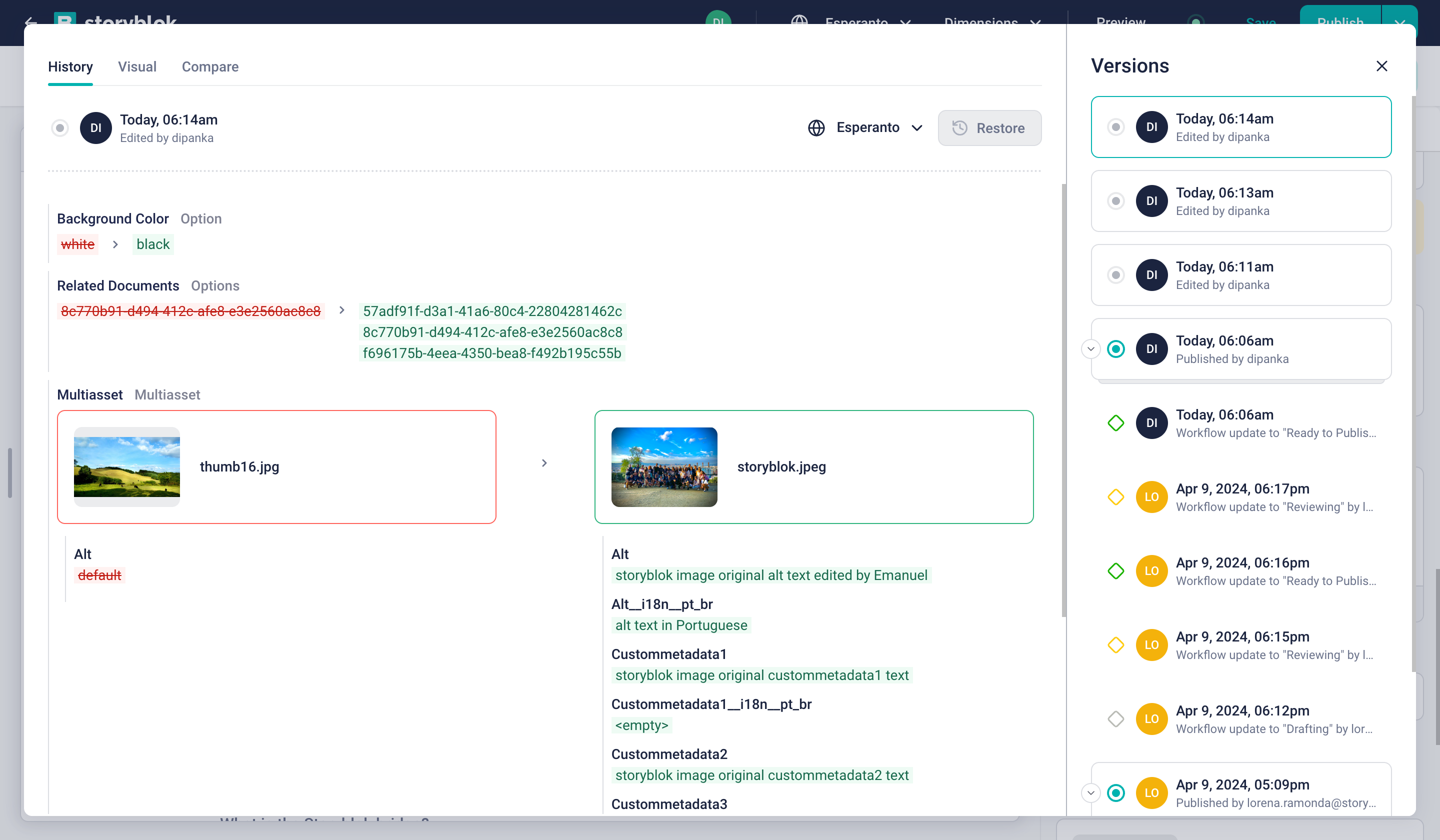
You can also use the Visual History feature to see it from the perspective of the front end alongside those same records. This can help give an immediate idea of how obvious any changes are. Both tools allow you to restore to a previous, approved version.
No matter what tool you use, make sure it’s one that makes sense to your team. When there’s a breach, every second counts. Prompt incident response will rely on tools that allow you to identify and resolve the issue as quickly as possible.
These security standards stack. Tracing versions is easier and more reliable with a strict PoLP in place. Never be afraid to double down on security!
3. Active maintenance of content integrity
“Content integrity” refers to ensuring your assets are all accurate, consistent, and reliable for both humans and machines. It’s a simple name for a challenging prospect, especially for an enterprise! But fortunately, a CMS can be your secret weapon for keeping content at its highest quality on a massive scale.
Look for structured content schemas that can help you enforce a content validation process. This helps to automatically ensure all assets are up to your standards. A few examples of this might be:
- The ability to mark certain fields as “required” to ensure that nothing goes through without critical data
- Enforced component structure to ensure consistency across all channels
- Mandatory schema validation before publication to ensure structural integrity
You can tweak it to fit your content strategy, but as long as you’re providing predictable, structured content, it’s a win for AI and your brand.
4. Custom workflow governance that doesn’t slow down teams
Workflows are a great way to keep operations organized and limit opportunities for content corruption. Namely, they can be used to enforce approvals – you and your team can choose stop points that require a certain role’s approval before a final stage, like publication, to ensure all review and governance processes are followed.
The “custom” part is important here, too. Depending on your industry or content needs, you might need a few different stages or approvals to safeguard your content:
- Legal and/or regulatory compliance reviews
- Tone of voice reviews for high-impact content types
- A required approval process from one or more senior team members for sensitive content
Even better is the option to go for multiple workflows. This enables parallel work without creating bottlenecks – apply rules for different teams, review options pending content type, standards for different topics, and so on. It helps make governance an everyday part of publication without losing velocity or adding too much extra burden.
Key takeaways: Your CMS is now part of your security perimeter
AI has made content enterprise critical. By extension, your content infrastructure is just as indispensable.
CMS security doesn’t just protect your content. It protects the systems that distribute it, the data they contain, and the trust your audience has in your brand. Choosing a CMS that can act like the fortress you need is the key to securely scaling content in the AI era with confidence.