Content Observability Explained

Storyblok is the first headless CMS that works for developers & marketers alike.
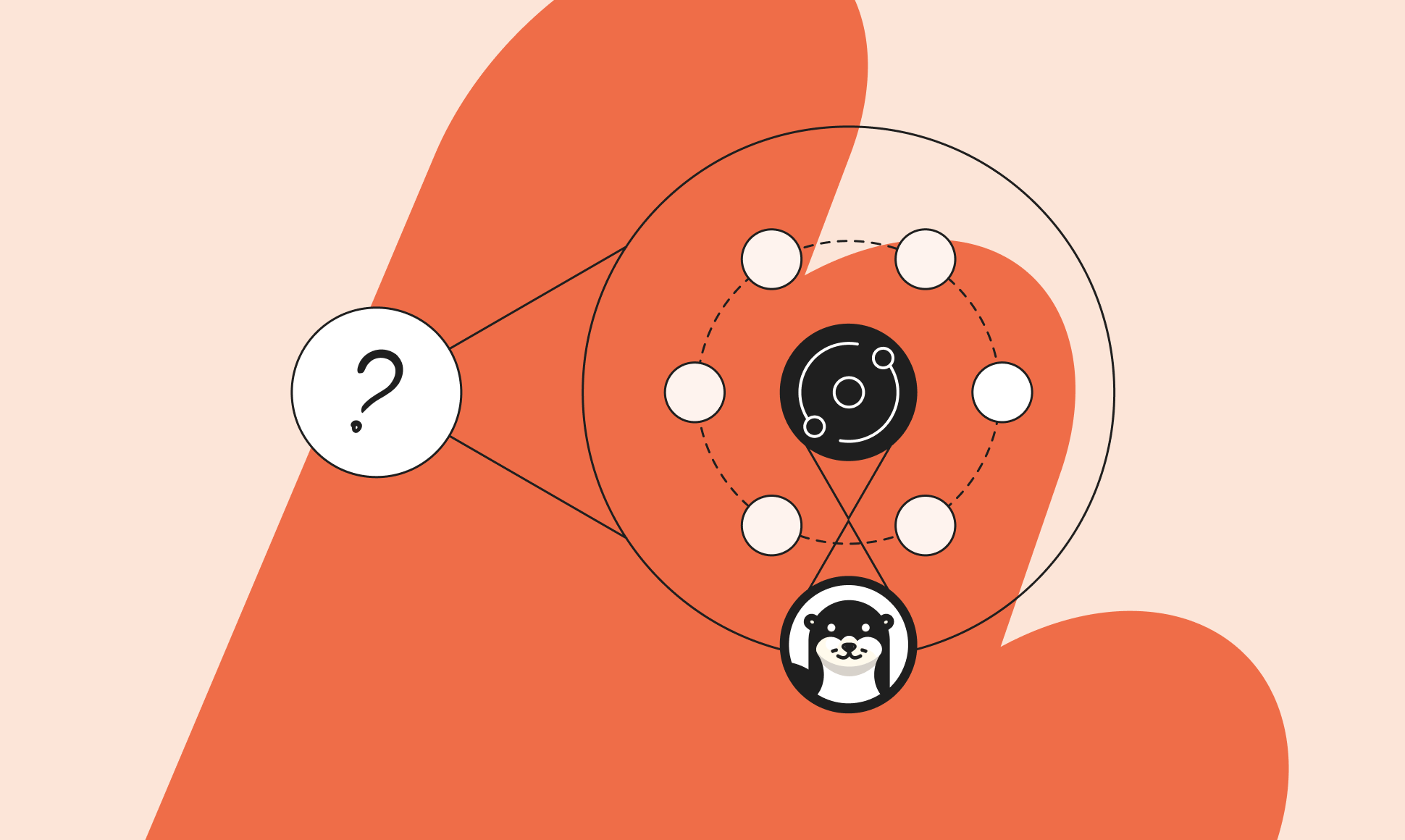
Knowing what content you have, how it performs, and how AI interprets it.
Most marketing teams think they know their content. They can tell you what’s been published recently, which pages perform well, and which campaigns are live. But as content ecosystems grow across multiple markets, languages, and channels (and now feeding the AI search models) truly knowing your content becomes increasingly complex.
Today, content lives everywhere. It evolves, duplicates, and gets reinterpreted not only by humans but also by machines. What used to be a manageable editorial calendar has turned into a living, breathing network of assets. How do you know what’s really working? That’s where content observability comes in.
What is content observability?
Content observability is the continuous ability to see, understand, and act on the state of your content across every channel and system. It’s the shift from auditing occasionally to knowing continuously.
Traditional analytics tools tell you which pages get clicks. Audits reveal what’s outdated. However, observability combines those insights into a single dynamic picture: what content exists, its health, performance, and how it is represented by AI models.
Content observability works much like software observability. Just as engineers rely on observability to understand complex systems, content teams now require the same level of clarity of their work.
And as content becomes enterprise-critical in 2026, organizations should treat it as a key continuous practice. Instead of metrics buried in disconnected tools, content observability connects the dots between content health, performance, and AI visibility.
Content operations vs. content observability
Content operations and content observability are part of the same story. They simply play their roles at different stages of the content lifecycle. Knowing where one ends and the other begins is how teams build a complete, future-ready content strategy.
Content operations cover everything that happens before and during publishing: from strategy and production to management and delivery. It’s the framework that keeps content organized, on brand, and ready to perform across every channel. Strong operations are what make scaling possible.
Content observability begins once your content is out in the world. It’s the ongoing process of tracking how that content performs, how fresh and accurate it remains, and how it’s represented across channels and AI-powered search. Observability gives teams the clarity to see how content behaves, how AI interprets it, and where improvements will have the most impact.
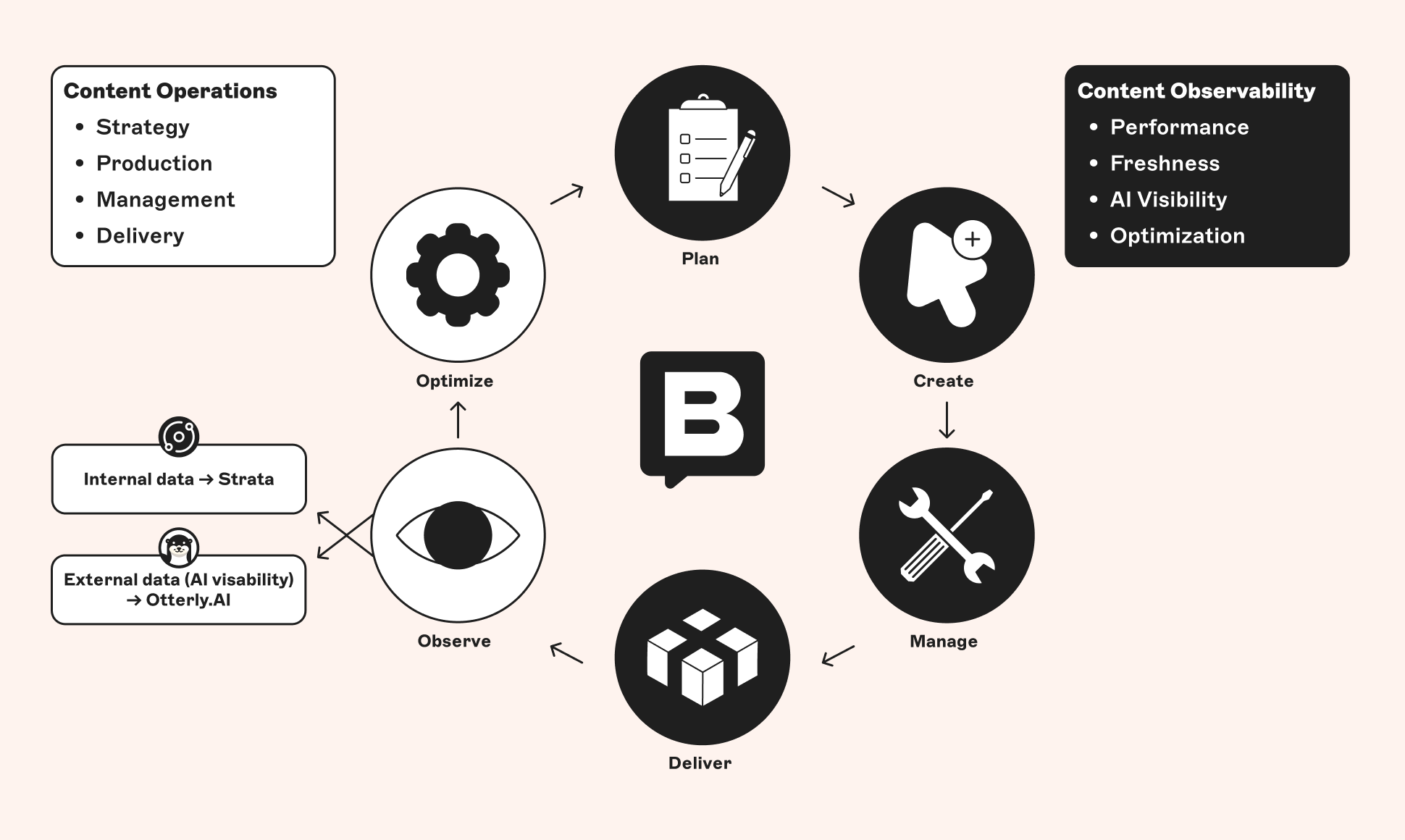
Together, they create a continuous feedback loop:
- Content operations: plan, create, and publish.
- Content delivery: distribute content across every channel.
- Content observability: monitor, analyze, and learn from live performance.
- Feedback loop: insights from observability guide updates and new production.
Why content observability matters
The rise of AI-powered discovery has made visibility less predictable. Your audience may never visit your site directly. Instead, they might encounter your content through an AI summary, a chatbot, or a voice interface.
That means a brand’s reputation and reach depend on how accurately these systems understand its content. If the AI quotes an outdated product description or pulls from a duplicate article, your message becomes fragmented.
Observability helps prevent that. It ensures your live content reflects your latest positioning and is being interpreted correctly by both users and AI. In other words, it’s how teams stay accurate, visible, and consistent in an AI-driven world.
The five pillars of content observability
1. Inventory awareness
You can’t improve what you can’t see, right? Inventory awareness means having a complete, up-to-date map of your live content: what exists, where it’s published, and who owns it.
As brands scale or expand globally, content often gets duplicated across markets or locked in silos. Observability tools help visualize this sprawl, so teams know which assets are driving value and which are adding noise.
2. Performance and engagement
Beyond surface metrics, observability looks at how content really performs. Is it delivering conversions? Are readers completing desired actions? Are AI systems referencing it correctly?
In the past, traffic was often the main performance indicator. Now, performance is more about trust and accuracy across the full discovery chain.
3. Freshness and accuracy tracking
Even great content loses impact if it’s out of date. Freshness tracking ensures your brand voice and data stay current. It identifies pieces that need updates or re-validation before they drift too far from reality.
This pillar turns maintenance from a reactive chore into a proactive routine. By measuring content freshness and accuracy, teams can prevent outdated information from being propagated by AI search or third-party sources.
4. Duplication and conflicting messages
Duplicate or conflicting content creates confusion for both users and algorithms. When two pages make slightly different claims about a product, which one should AI believe?
Observability highlights these overlaps early, helping teams merge or retire redundant pages before they harm authority. Less duplication also means stronger SEO and more reliable data for AI training models.
5. AI mentions and citations
Finally, content observability extends beyond your owned channels. It tracks how your brand is being mentioned, cited, and summarized by platforms like ChatGPT, Perplexity, or Google’s AI Overviews.
Visibility within AI-generated answers is the newest and most dynamic layer that companies should track. Observability helps you see where your content is showing up and whether it’s being represented accurately.
How to build content observability into your workflow
Implementing observability doesn’t require reinventing your tech stack. It starts with a mindset: treat content like an evolving system that needs constant monitoring, not just publishing.
Here’s a practical framework:
1. Create a complete content inventory
Use your CMS or connected tools to list all live content. Include metadata like owner, last update date, target market, and purpose. This establishes your baseline.
2. Define what “healthy content” means for your brand
Set measurable standards for freshness, accuracy, and alignment. For example: product pages updated within 90 days, localized content reviewed every quarter, AI citations checked monthly. It’s crucial that everyone on the team is on the same page, so no matter what happens, you have a guideline.
3. Identify high-impact areas first
Not every outdated page is a crisis that needs to be fixed ASAP. Prioritize updates by traffic, conversions, or strategic importance. Fix the content that influences brand visibility or revenue before long-tail assets.
4. Integrate observability tools
Use analytics dashboards, AI-visibility reports, or specialized solutions to monitor content health automatically. The key is connecting performance metrics with content structure, not just looking at numbers in isolation.
5. Build a review process
Observability is an ongoing process that needs its own special rhythm. Weekly or monthly check-ins keep your data accurate and prevent drift. The main idea is that it’s something continuing, constant, and repetitive, not a one-time project.
6. Close the feedback loop
When insights surface issues, act on them quickly. Refresh content, update metadata, or consolidate duplicates before they accumulate.
How Storyblok brings observability to the CMS layer
Most CMS platforms focus on creation and publishing. Few address what happens after content goes live. Storyblok’s ecosystem is changing that by embedding observability directly into the content lifecycle.
Strata: see everything, solve anything
Storyblok’s Strata represents a major leap forward in how brands understand and optimize their content. Fueled by a vector database and powered by AI-driven semantic search, Strata makes content discoverable by meaning, not just keywords — helping teams find, organize, and deliver content with intelligence and speed.
For brands, that means more than better search results. It means true visibility across massive content libraries, smarter workflows, and content that’s ready for AI-powered experiences from day one.
Strata release is planned for 2026, but you can request early access here.
With Strata, companies can:
- Identify and eliminate content debt: Surface outdated, redundant, or underperforming content early, and act before it slows down performance.
- Improve AI access and understanding: Vectorized content enables AI platforms to interpret relationships and context accurately, ensuring brand information is represented correctly across tools and channels.
- Deliver personalization at scale: AI-powered categorization and recommendations allow content to adapt to each user’s intent, preferences, and behavior.
- Extract insights automatically: Strata’s knowledge extraction and real-time analytics reveal how content is used and how fresh it is, making optimization continuous instead of reactive.
By combining semantic intelligence with actionable insights, Strata turns content management into an active, measurable practice. It helps brands move from simply storing content to truly understanding it, seeing how it performs, how it’s used, and how it contributes to business goals.
But what can you do right now before the Strata launch?
OtterlyAI: turning content visibility into measurable AI presence
Modern content strategies now extend beyond creation. With Storyblok’s OtterlyAI integration, brands gain access to the most relevant and up-to-date tools for the AI era.
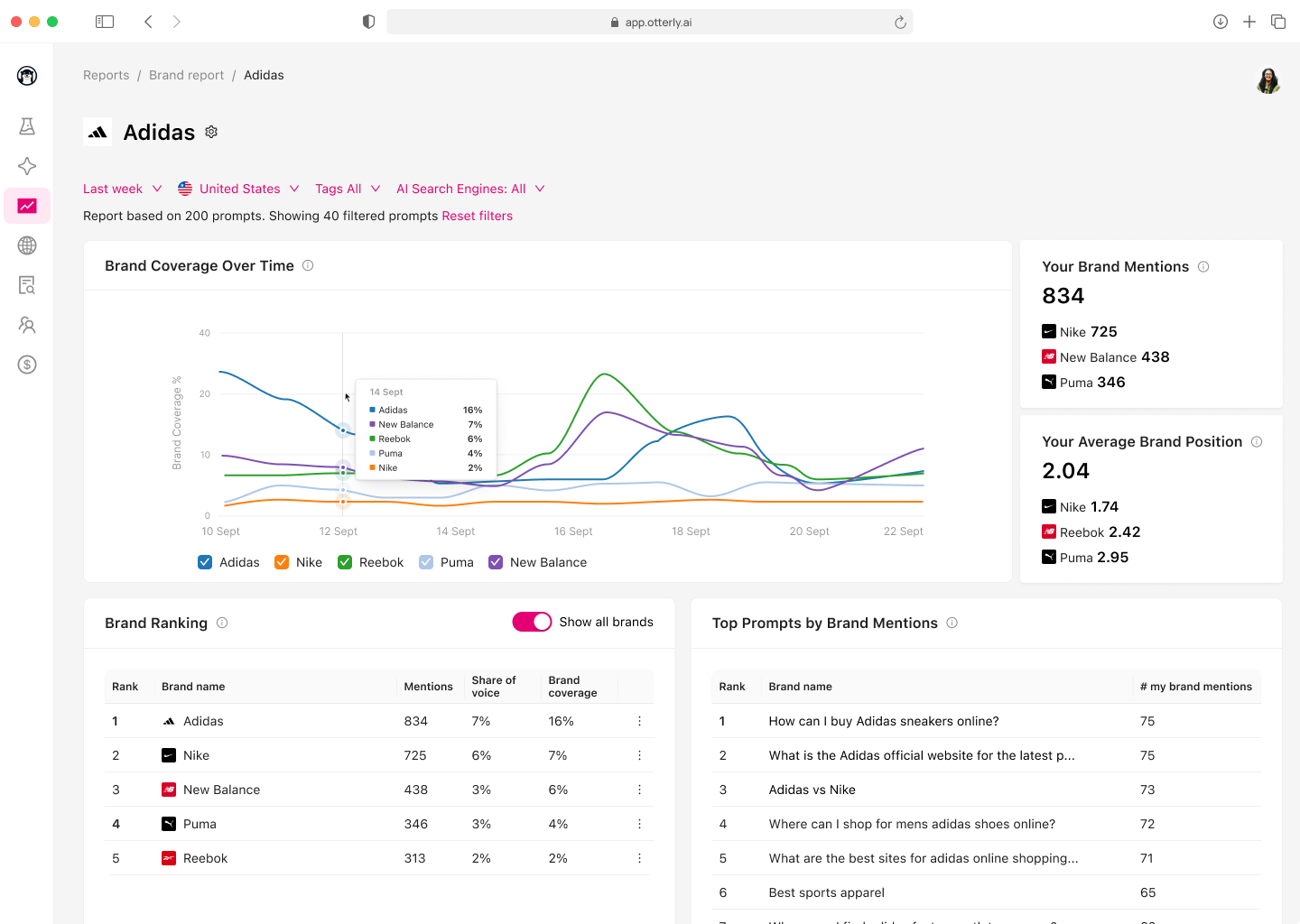
OtterlyAI monitors how your brand and website appear across AI-driven search experiences such as Google AI Overviews, ChatGPT, Gemini, Copilot, and Perplexity. It shows where your content is cited, highlights the prompts that surface it, and reveals where you’re missing visibility. When paired with Storyblok, it gives teams a complete loop: create, deliver, and be found.
What OtterlyAI does:
- Search prompt monitoring
Discover which questions and search prompts trigger your content in AI platforms. Track these queries daily to understand exactly how AI systems answer within your category. - Measure what matters
See performance data across channels and touchpoints. Identify which assets drive the strongest impact and which fall behind in AI visibility. - Benchmark competitors
Compare your brand’s AI search coverage to peers in your industry. Spot opportunities to gain share where competitors are cited more often. - Trace Content Influence
Find out which URLs, pages, or assets are being referenced by AI systems. Use these insights to refine messaging, strengthen authority, and correct outdated information. - Run GEO Audits
Understand how your brand performs in different regions. Analyze who else shows up, and review key local tactics such as digital PR, on-page optimization, and user-generated content performance.
Being #1 on ChatGPT for brand mentions and citations isn’t just possible — it’s doable. In fact, 95% of OtterlyAI customers see measurable insights within their first month of monitoring.

From visibility to action: Connecting Strata and AI monitoring
Content observability goes beyond what happens inside your CMS. To see the full picture, teams need to understand how content performs both within their ecosystem and across AI-driven discovery. That’s why Strata and OtterlyAI work best together.
Strata delivers internal visibility by helping teams monitor freshness, structure, and context. OtterlyAI extends that view outside, showing where content is cited, summarized, and surfaced in AI search results.
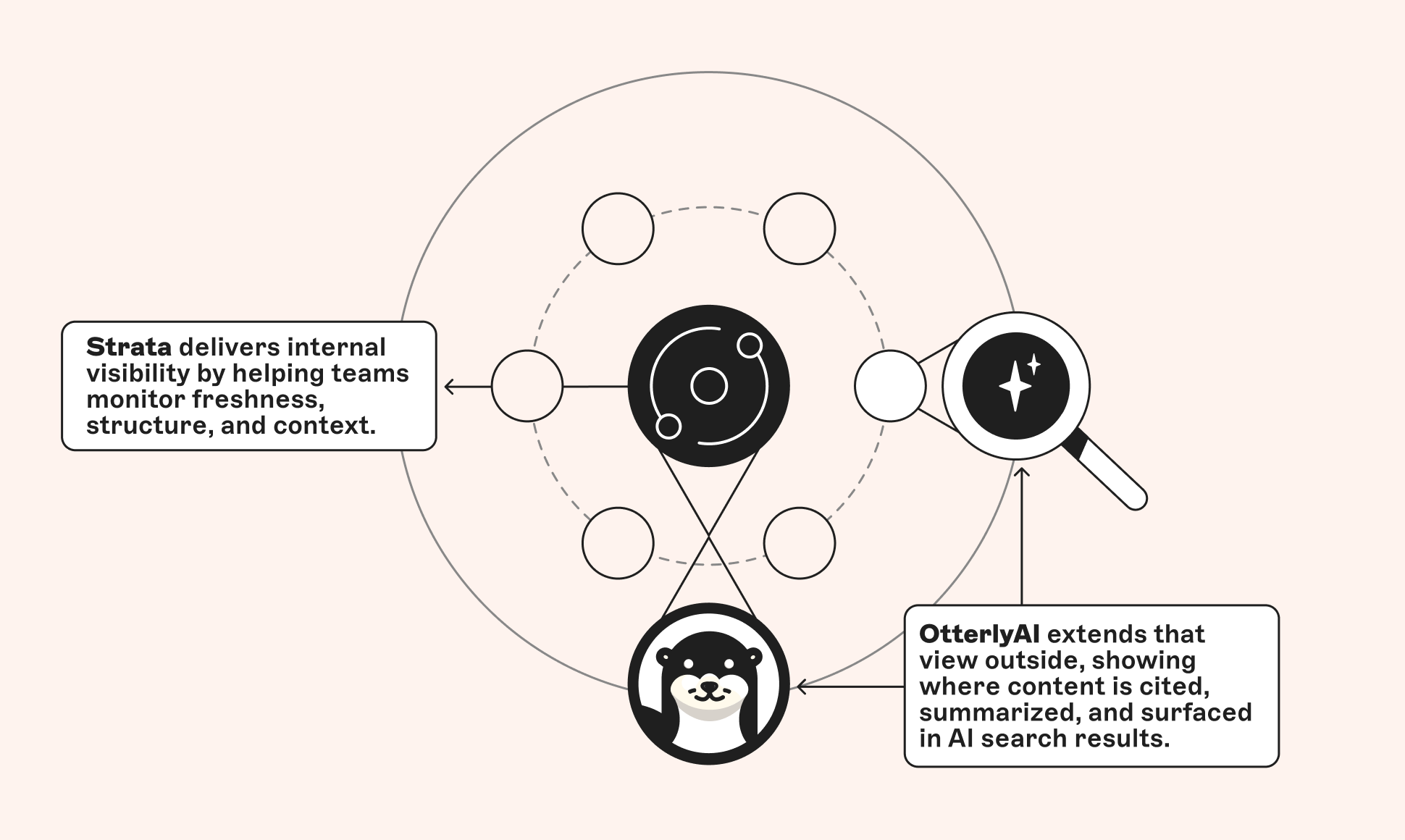
Together, they create a closed feedback loop:
- Strata tracks how content is performing and how healthy it is inside your ecosystem.
- AI-visibility tools show how that same content is being cited and summarized externally.
- The insights feed back into your workflows, guiding updates and optimization.
The outcome is an adaptive content system that keeps improving through every iteration, with stronger accuracy, better reach, and deeper visibility wherever your audience discovers you.
Key takeaways
- Content observability is an emerging discipline that helps teams continuously monitor and improve their content’s health, performance, and visibility across every channel and AI search platform.
- It brings together four essential areas: inventory awareness, freshness and accuracy, duplication management, and AI mentions and citations.
- Traditional audits are static snapshots. Observability turns that into an active, ongoing process that connects insights from inside your CMS to how content performs externally.
- OtterlyAI provides teams with immediate visibility into how their content appears in AI search, showing when it’s cited, what prompts trigger it, and where opportunities are being missed.
- Strata, coming in 2026, will expand that observability further with semantic search, automated tagging, and real-time insights on freshness and structure, helping teams understand their content through meaning and context, not just keywords.
- Together, OtterlyAI and Strata form a complete content observability ecosystem: one focused on accuracy, visibility, and continuous improvement across human and AI discovery.
Storyblok is leading this shift, giving brands the tools to see their entire content landscape clearly, measure how it performs, and ensure it stays visible and trusted in the AI-powered world.