Brand marketing in the age of AI: The new tech layer

Storyblok is the first headless CMS that works for developers & marketers alike.
If you work in marketing, you hear it constantly.
This has changed.
That no longer works.
Here’s the new way to do things.
Over the past few years, almost every development, from new platforms to new algorithms to AI, has been framed as a fundamental reset. It can easily feel like everything you knew about brand building is suddenly outdated.
The good news is: it isn’t.
Brands are still built the same way they always have been. Human memory hasn’t suddenly evolved, and people still rely on familiarity. Mental availability is still created through repetition, consistency, and clear brand signals over time. And humans, not machines, still make the final purchase decision. All of that remains true.
What has changed is something more subtle and more technical.
Discovery and research are now often supported by AI-powered tools. When people hesitate, want to compare options, or need help navigating complexity, they increasingly turn to AI-assisted search and conversational tools to orient themselves, summarize information, and narrow their choices. Research shows that 61% of U.S. adults have used generative AI in the past six months, often for everyday information-seeking and planning tasks.
AI doesn’t replace brand building, nor does it decide for people. But it increasingly mediates how brand information is retrieved, summarized, and presented before a decision is made.
Which means brand marketing now operates across two connected layers:
- Human memory, built through exposure and repetition.
- Machine interpretation, shaped by how clearly brand meaning can be understood and reused by AI systems.
If your brand isn’t easy for humans to understand quickly, it won’t be remembered. And if it isn’t interpretable by machines, that familiarity may never surface when AI helps shape the decision.
And that’s the real change.
What hasn’t changed: How brands enter human memory
Before we talk about AI (sorry, we know), it’s worth grounding this discussion in something far more stable: how human memory actually works.
People don’t store brands as detailed profiles in their heads. They store associations — loose bundles of meaning that can be retrieved quickly when a buying situation appears. When someone feels a need, the brain doesn’t scan the market objectively. It pulls up whatever feels familiar, relevant, and easy to recall.
This is the essence of mental availability.
Decades of behavioral science show that recall is influenced by three core factors:
- Frequency: how often a brand is encountered.
- Consistency: how predictable its signals are over time.
- Clarity: how quickly its meaning can be understood.
These principles are closely related to the availability heuristic, a well-established cognitive bias where people judge things as more important, trustworthy, or preferable simply because they’re easier to recall.
That’s why being “top of mind” is the outcome of repeated, coherent exposure over time.
This is also why mental availability isn’t built through one-off campaigns or clever messaging alone. It’s built through systems, the underlying architecture that ensures every interaction reinforces the same core meaning.
Those systems include:
- How a brand consistently describes what it does.
- How it uses language and framing across channels.
- How quickly someone can grasp why it’s relevant.
Offline channels still play an important role here. Broad-reach advertising, sponsorships, physical presence, and real-world touchpoints continue to reinforce memory structures in many categories. Digital channels extend and repeat those signals. Together, they create familiarity long before a decision is made.
What mental availability is not:
- It’s not short-term performance marketing.
- It’s not SEO or AI visibility.
- And it’s not something AI can manufacture on its own.
Mental availability is the foundation. It determines whether a brand even enters the consideration set when a buying moment arrives.
But not every buying moment looks the same. The role mental availability plays depends heavily on the type of decision someone is making and how much effort that decision requires.
When top of mind is enough and when it isn’t
In some categories, mental availability, aka “top of mind” alone still drives choice.
Low-involvement, habitual purchases are the clearest example. When someone buys a burger, reaches for a familiar soft drink, or picks a snack, decisions happen fast. Recall dominates. People choose brands they already know, like, or crave in the moment. In these situations, AI may play little or no role at all.
But not all buying decisions look like this.
As purchases become more expensive, more complex, or less familiar, behavior changes. People slow down. They want reassurance. They compare options. And this is where AI-powered tools are far more likely to appear.
In higher-involvement decisions:
- Mental availability often determines which brands get recalled or shortlisted.
- AI-assisted research helps people narrow options and validate their choice.
In other words, mental availability can get you considered, but it doesn’t always get you chosen.
Decision-making: AI assists, humans decide
When people move beyond recall and into evaluation, AI-powered tools increasingly help them compare, clarify, and validate their options. AI doesn’t replace human judgment or make decisions on behalf of people. Instead, it supports the process around decision-making.
McKinsey describes AI-powered search as a “new front door to the internet,” reflecting a shift in how people discover, explore, and evaluate options before committing.
AI-powered search tools tend to appear:
- When a purchase feels unfamiliar or higher risk.
- When options need to be compared or explained.
- When people want clarity before moving forward.
In these moments, AI acts as a retrieval and interpretation layer. It decides which information to surface first, how to summarize it, and which signals feel most relevant. Humans then evaluate that information, apply their own preferences, and make the final choice.
So AI doesn’t change how people decide. It changes what information is most visible when they do.
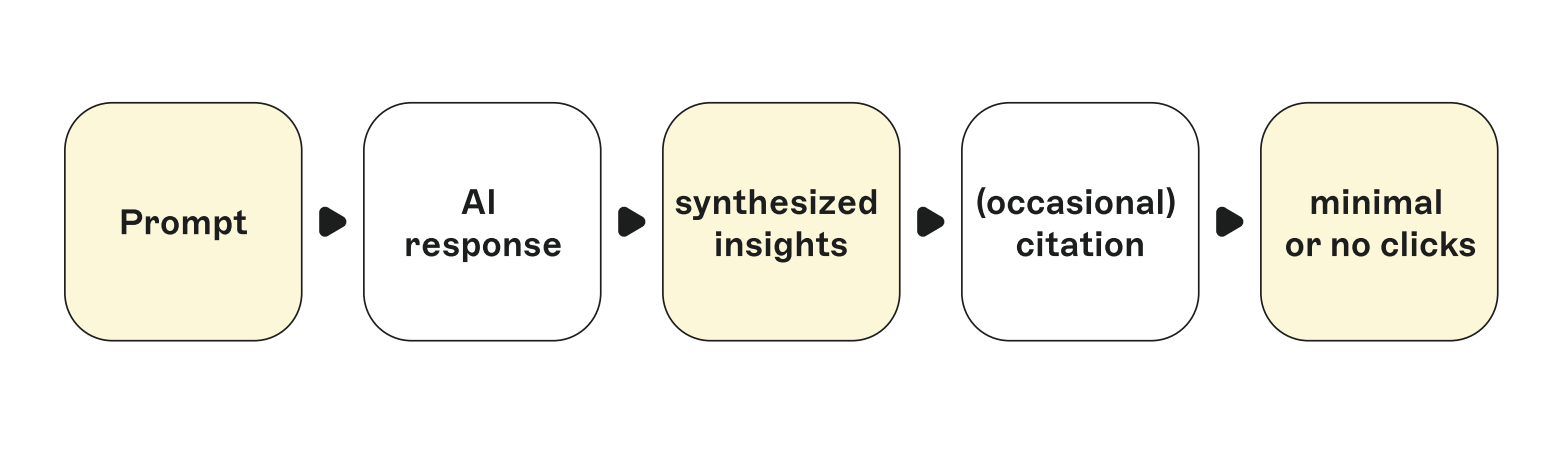
The new customer journey in the AI era
This is also where consistency becomes more visible and more fragile.
When AI-powered systems summarize or describe a brand, they effectively become part of the brand experience. If what those systems surface aligns with the brand’s own messaging, the decision process feels smooth. If it doesn’t, friction appears.
Humans are sensitive to inconsistent signals. When language conflicts, claims don’t align, or information varies across sources, cognitive fluency drops. Lower fluency introduces friction and slows decisions.
So the risk isn’t that AI deliberately misrepresents a brand. The risk is that inconsistencies between brand intent and machine interpretation quietly undermine confidence at the exact moment people are trying to decide.
79.5% of consumers say that when a brand looks or sounds inconsistent, it either makes them trust the brand less ( 28%) or raises doubts (51.5%)
This is why brand marketing in the age of AI expands beyond exposure. Now it's also about making sure the meaning built through brand exposure can be reliably carried forward when AI helps people research and decide.
That’s where mental availability intersects with something new: machine availability.
How to achieve machine availability (aka AI visibility and discoverability)
Once we’ve established that AI doesn’t replace human choice but influences how information is surfaced, the next question becomes practical: how do we make brand meaning legible to machines?
The answer lies in structured content.
What structured content really means
You might think that structured content is how a page looks visually, but in reality, it’s how information is organized, labeled, and stored so that machines like AI search engines and large language models can interpret it reliably.
In traditional CMS setups, content often lives as blocks of free-form text. For humans, that’s fine. For machines, it’s messy, meaning they must guess relationships, entities, and meaning.
In contrast, structured content breaks information into defined fields and components, each with a clear semantic purpose. For example, instead of a single blob of text, content is organized into parts like:
- Title
- Category
- Publish date
- Author
- Body text
- Images
…with each part labeled and stored according to a defined schema. This makes the information both predictable and reusable.
One of the most common misconceptions about “AI-ready” content is that it’s about how a page looks.
From a human perspective, two pages can appear identical: same layout, same headlines and same copy.
But for AI systems, they can be fundamentally different. AI search engines and large language models don’t see visual hierarchy, spacing, or design intent. They don’t infer meaning from layout. They interpret data, relationships, and signals beneath the surface.
How structured content improves visibility in AI search
Structured content makes it easier for AI systems to understand:
- What your content is (entities)
- How those entities relate to each other (hierarchies and relations)
- Why the content matters (semantic context and metadata)
When content is organized in this way, AI systems can interpret it with confidence and repeat it accurately in summaries and recommendations instead of drawing from fragmented or inconsistent text.
Think of structured content as the foundation for clear machine interpretation, just as consistent branding is the foundation for human recall.
Want to go deeper on structured content? If AI-powered discovery is part of your future, structured content is part of the foundation. Learn how it works and why it matters.
Storyblok’s approach to structured content
Storyblok was built around this idea from the very beginning. Its headless, API-first architecture stores content as structured components made of defined fields (e.g., text, numbers, images, metadata), rather than as monolithic pages.
Here’s how that works in practice:
- Content is composed of reusable blocks: Each block represents a meaningful entity (like a product, article, or event) with clearly labeled attributes.
- Visual editing without sacrificing structure: Editors interact with content visually, but Storyblok still stores this content in a structured schema behind the scenes, available as JSON via APIs.
- Metadata and hierarchy become explicit: Because every field has a purpose and label, developers can expose that structure to frontend systems as semantic HTML or schema markup, which in turn helps AI search understand context and relationships.
The result is content that’s:
- Consistent across channels
- Easy to reuse and update
- Predictable for machines and humans alike
- Prepared for emerging discovery tools like AI search, generative assistants, and answer engines
What to do next: preparing your brand for AI-powered discovery
As AI increasingly supports research and validation, brand meaning needs to be not only memorable but also retrievable and interpretable by machines. That extends brand building with a new technical layer that marketers should be aware of. Structure, clarity, and system-level decisions now play a quiet but critical role in how brand meaning holds up during AI-assisted discovery.
If you want to explore how AI search, structured content, and brand visibility connect in practice, you can dive deeper into our AI Knowledge Hub.