Are You Smarter Than Jev? Picking Hero Images When Assets Fit More Than One Category

Storyblok is the first headless CMS that works for developers & marketers alike.
Lights up. The studio audience settles in.
Contestant, your category is Kitchen Appliances. For 500 points: a blog post is tagged Oven. That's all you get, no title and no text. Which picture goes on top?
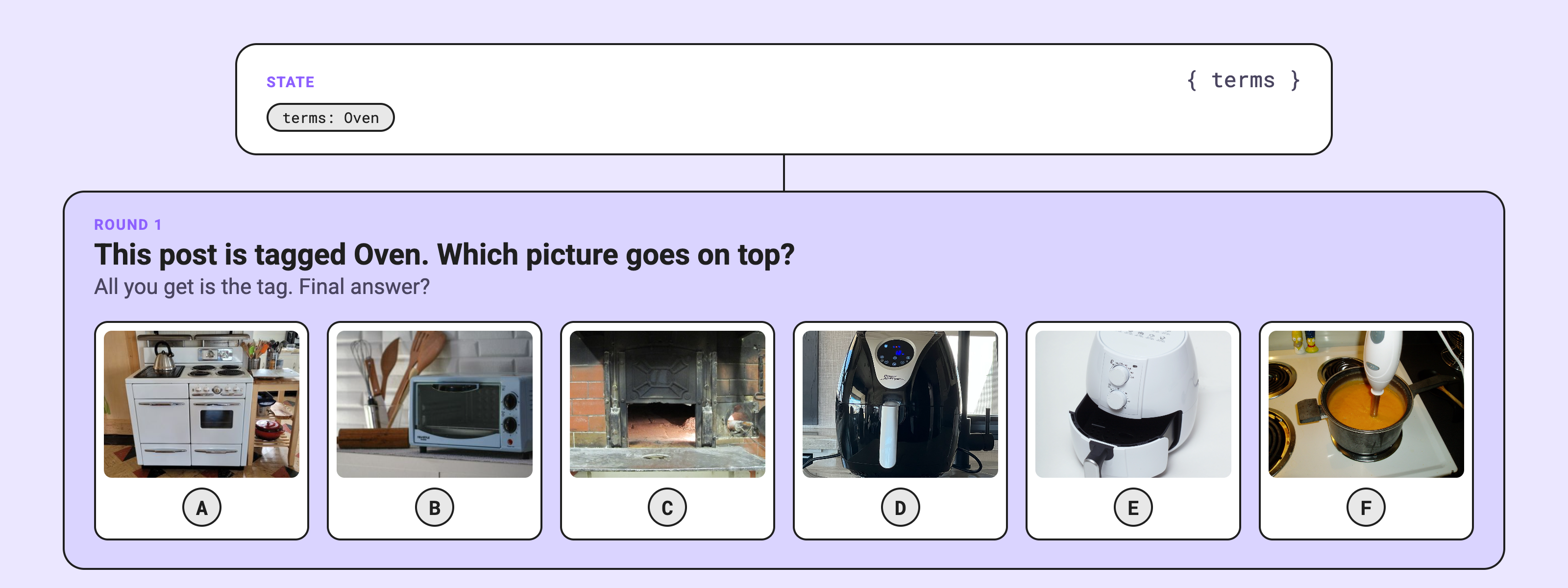
Lock in your answer. A range stove is an oven. But so is a brick pizza oven. And so, technically, is a toaster oven (yea the toaster oven is just happy to be included). The air fryers are what we will refer to as fallbacks.
Did you pick the air fryer? Ahhh, wrong answer. You lose out on $500.
You’ll get a second try (and find out the real answer) later on in this written game show.
Most images in a real asset library fit more than one category. A room shot shows a sofa, a rug, and the curtains behind them. A photo of a toaster shows the appliance and the stainless steel it's made of. Taxonomy terms say what a post is about. They don't say which of several matching images fits it best, and picking by hand means opening every post and scrolling the asset library each time.
The first Jev and Taxonomies experiment used Jev to tag 2,200 home goods posts. This one gives those posts a hero image, twice:
- Experiment 1: the posts as the first experiment tagged them. Most carry one tag.
- Experiment 2: the same posts, edited to also mention a material and a related product, then tagged again. Most carry three.
With one tag, a few lines of code over Jev's scores beat Jev's own pick. With more tags, Jev's pick comes out ahead at every tag count.
You get to play along. Each round first shows you only the tags, the way Jev's scores see a post. Later you get the post itself, the way Jev's pick sees it.
What are Jev images?
Jev is the first public System One model from TypeSafe AI. The first Jev and Taxonomies article explains how it works.
TypeSafe announced “Dreamer-ready” image support **** on October 14, 2026, alongside Jev 1.14, and it already worked on jev-1.13.0. It’s good enough to build prototypes and try ideas, but not production ready. The request format can still change, so images are opt-in: every request that contains an image needs the TypeSafe-Danger-Zone-Images: true header. The request carries the image bytes, as base64 or a multipart file part, so the script downloads each asset from Storyblok first, and a picture can be a Choice option on its own.
Images are billed as input tokens at the same price as text. A full-size photo (1568 pixels wide) cost about 4,750 tokens in testing, and by default Jev allows 32k tokens per question, state included, so one request can't hold a whole asset library.
The TypeSafe images guide covers placement, size limits, and the multipart format.
Building the shortlist
The test space holds 2,200 posts across six taxonomies (Furniture, Appliances, Cookware, Lighting, Textiles, and Materials) with 44 terms, and an asset library of 61 images. Many images fit more than one category on purpose, such as a dining table with four chairs, or a stainless steel toaster. Others are traps, photos that look like they fit and don't. They get their own round later.
Jev can only pick from pictures it sees in the request, and every picture counts as input. Shrunk to fit inside 800 × 800, a picture costs about 1,300 tokens (the six-picture pick requests averaged about 8,400 input tokens), so all 61 images would come to roughly 80,000 tokens, more than twice the 32k Jev allows per question. Asking about each image separately would take 61 requests per post, about 125,000 for the 2,056 tagged posts. No way that’s happening. So the script works in two stages, the same way search works: a cheap step narrows 61 images down to six candidates per post, and Jev chooses among those six.
A human created the answer key by tagging the assets with all relevant tags. Jev didn’t have access to it. Every score in this article, for both experiments, uses that answer key.
The first stage, the index, sends Jev each photo once with one Noul per term:
Would
photowork as the hero image of a home goods blog post taggedterm? It works if a reader browsing that tag would recognize the photo as being aboutterm: the product itself, the product in use, or the material itself.
That makes a score table, one row per image and one column per term, built once before Jev sees any post:
Image |
|
|
|
|---|---|---|---|
Range stove | 0.98 | 0.18 | 0.02 |
Toaster oven | 0.97 | 0.08 | 0.01 |
Dining table with four chairs | 0.01 | 0.98 | 0.92 |
Single chair | 0.00 | 0.02 | 0.99 |
A post's shortlist comes out of that table with plain code: add up each image's scores for the post's terms, sort, and keep the top six. Six pictures plus the post fit under the 32k-token limit. The top of that ranking is also a pick on its own, the taxonomy only pick, and it costs nothing beyond the index.
const ranked = images
  .map((img) => ({ img, score: post.terms.reduce((sum, term) => sum + img.scores[term], 0) }))
  .sort((a, b) => b.score - a.score);
const shortlist = ranked.slice(0, 6);
Round 2: two tags
Welcome back, contestant. Round 2, for 1,000 points, same rules: all you get is the tags. This post carries Table and Chair, and these six images made its shortlist. Which one goes on top?
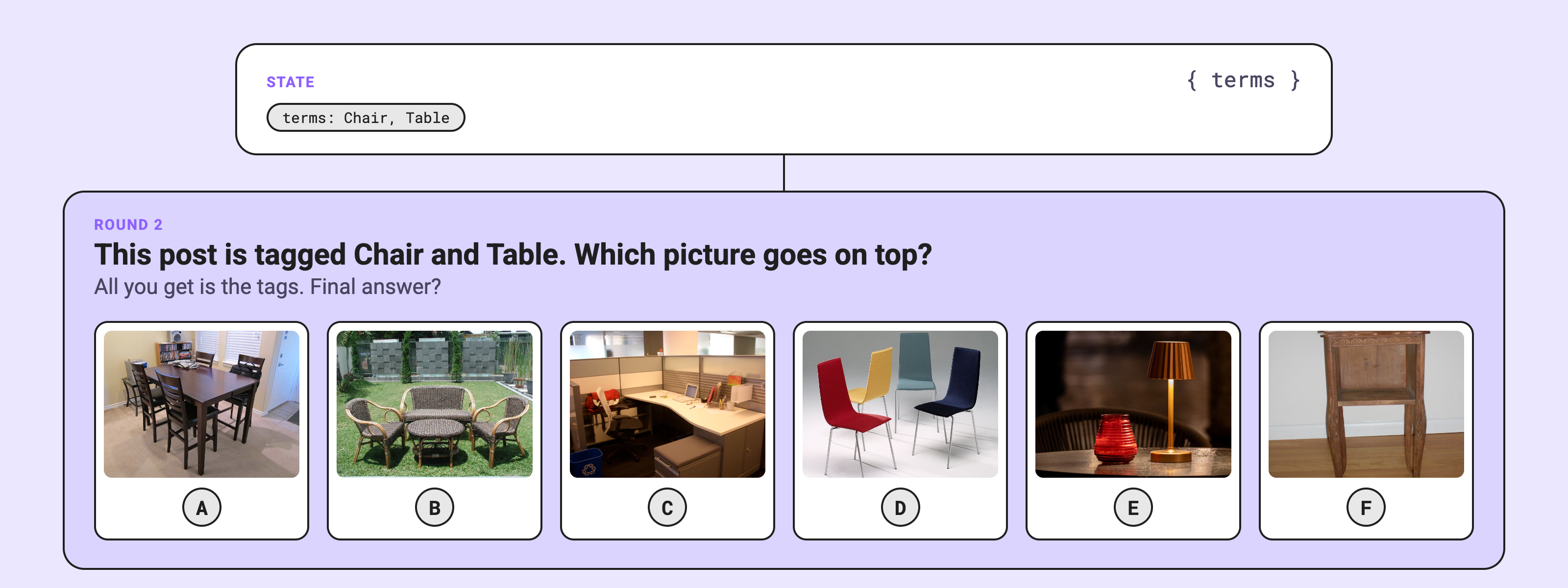
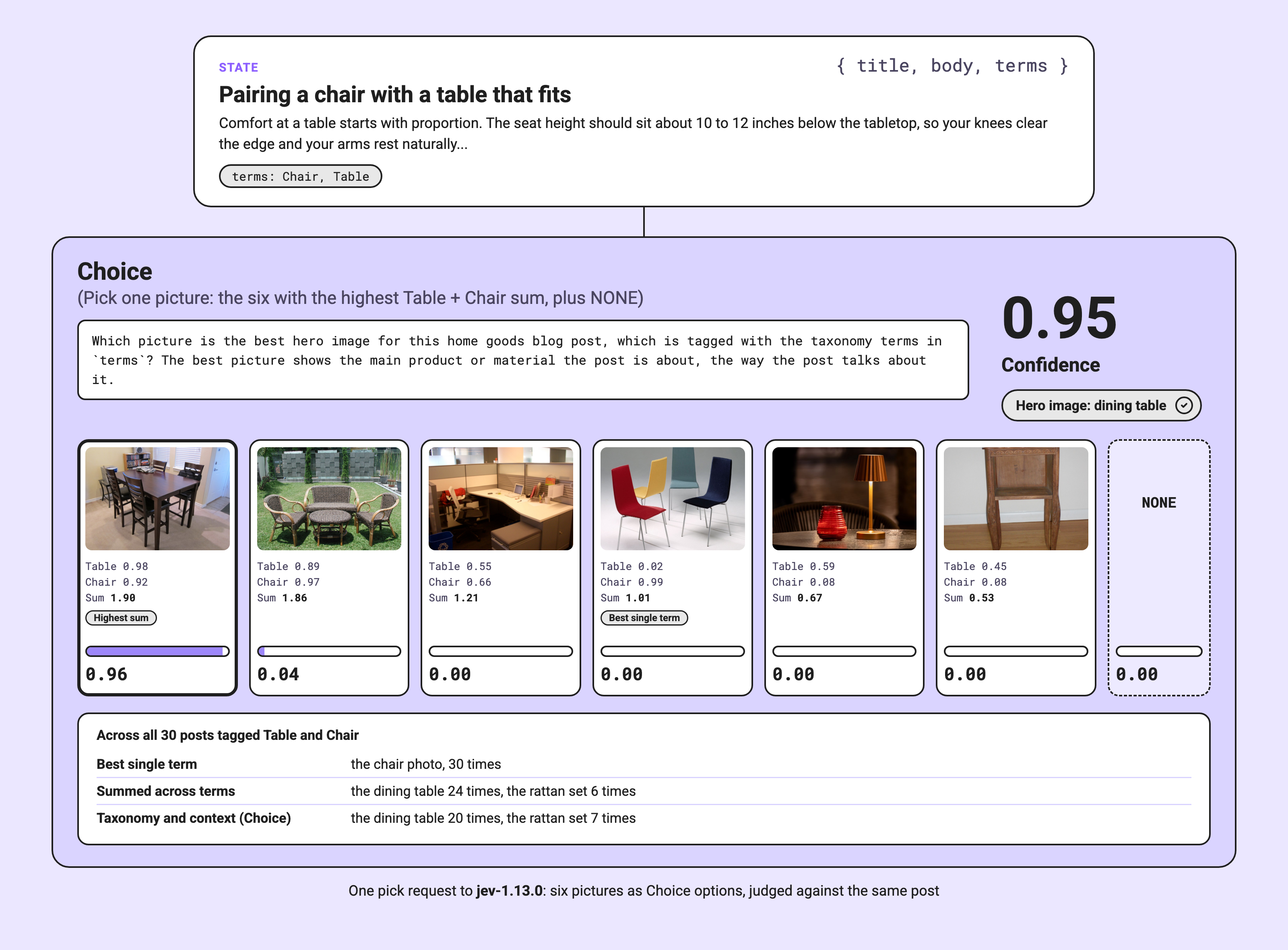
Lock it in. Here's the catch: with only tags, the answer depends on how you add them up. Ranking by each image's best single tag puts D, the four chairs, first, at 0.99 for Chair: a great chair photo with no table in it. Adding up the tags puts A, the dining table, first, at 0.98 + 0.92 = 1.90. If you said A, you're thinking like the shortlist code: summing is what it does, and in experiment 1 the shortlist built that way held a best-available image for all 2,056 tagged posts.
Letting Jev pick
The second stage, the pick, is the first request that reads the post. It sends the six shortlisted pictures as the options of one Choice, with the post's title, body, and terms in the state. This is the taxonomy and context pick:
import { TypeSafeClient, choice, image } from "@typesafe-ai/sdk";

const jev = new TypeSafeClient();
// picture() downloads the asset's bytes from Storyblok and wraps them with image()
const pictures = await Promise.all(shortlist.map(({ img }) => picture(img)));

const { answers } = await jev.systemOne(
  {
    model: "jev-1.13.0",
    state: { title: post.title, body: post.body, terms: post.terms },
    questions: {
      hero: choice(
        "Which picture is the best hero image for this home goods blog post (`title` and `body`), which is tagged with the taxonomy terms in `terms`? The best picture shows the main product or material the post is about, the way the post talks about it. Pick NONE only if none of the pictures shows the post's main topic.",
        { ...Object.fromEntries(pictures.map((p, i) => [`picture_${i}`, p])), NONE: "None of the pictures shows what the post is about." },
      ),
    },
  },
  { headers: { "TypeSafe-Danger-Zone-Images": "true" } },
);
Experiment 1 ran this on the posts as tagged. Most carry one term, because the first experiment tagged only each post's main subject. Real posts wander more than that, so experiment 2 changed the posts:
- Each of the 2,056 tagged posts was edited to add a sentence or two: the material the main product is made of, and a related product from another category, such as a rug under a sofa.
- Jev tagged the edited posts again, with one Noul per term: does this post cover the term, as a product it's about, its material, or something it discusses in more than a passing mention?
- The same shortlist code and the same pick ran on the new tags, and the picks were scored against the terms each edit set out to add.
Jev's new tags were right 90% of the time, and they caught 69% of the terms each edited post should carry (41% of the added terms alone). Most of the misses were side items mentioned in one sentence, like Rug (311 times) and Table Lamp (151 times). The edits took most posts from one term to three, and Jev's tags put most of them at two or three.
Round 3: three tags
Round 3, the double-points round. This post is from experiment 2, and all you get is its three tags: Stockpot, Stainless Steel, and Immersion Blender. Which picture goes on top?
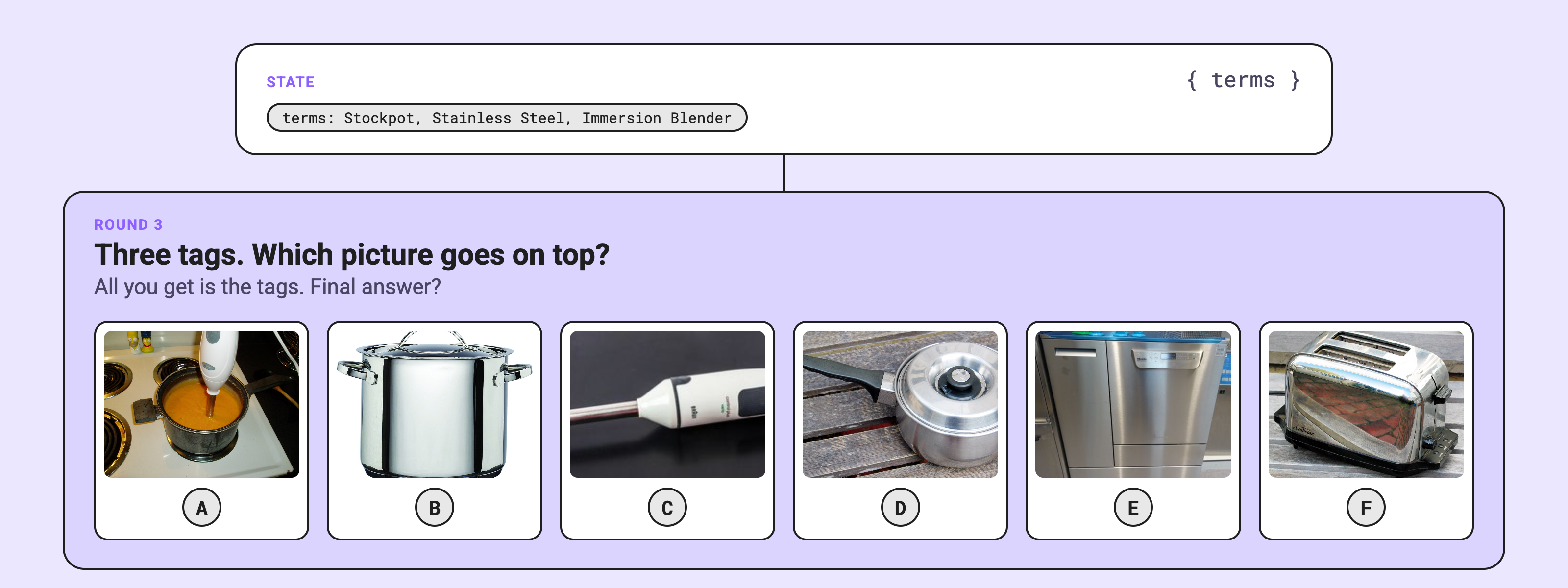
A looks like it covers all three. Is that your final answer? Hold that thought.
Diving into the result
Ready up, contestant. Time to redeem yourself. This time you get a glimpse into the posts’ context, and then Jev's answers.
Round 1 answer: the toaster oven
Back to round 1, for another shot at 500 points. Here's the Oven post, title and text this time:
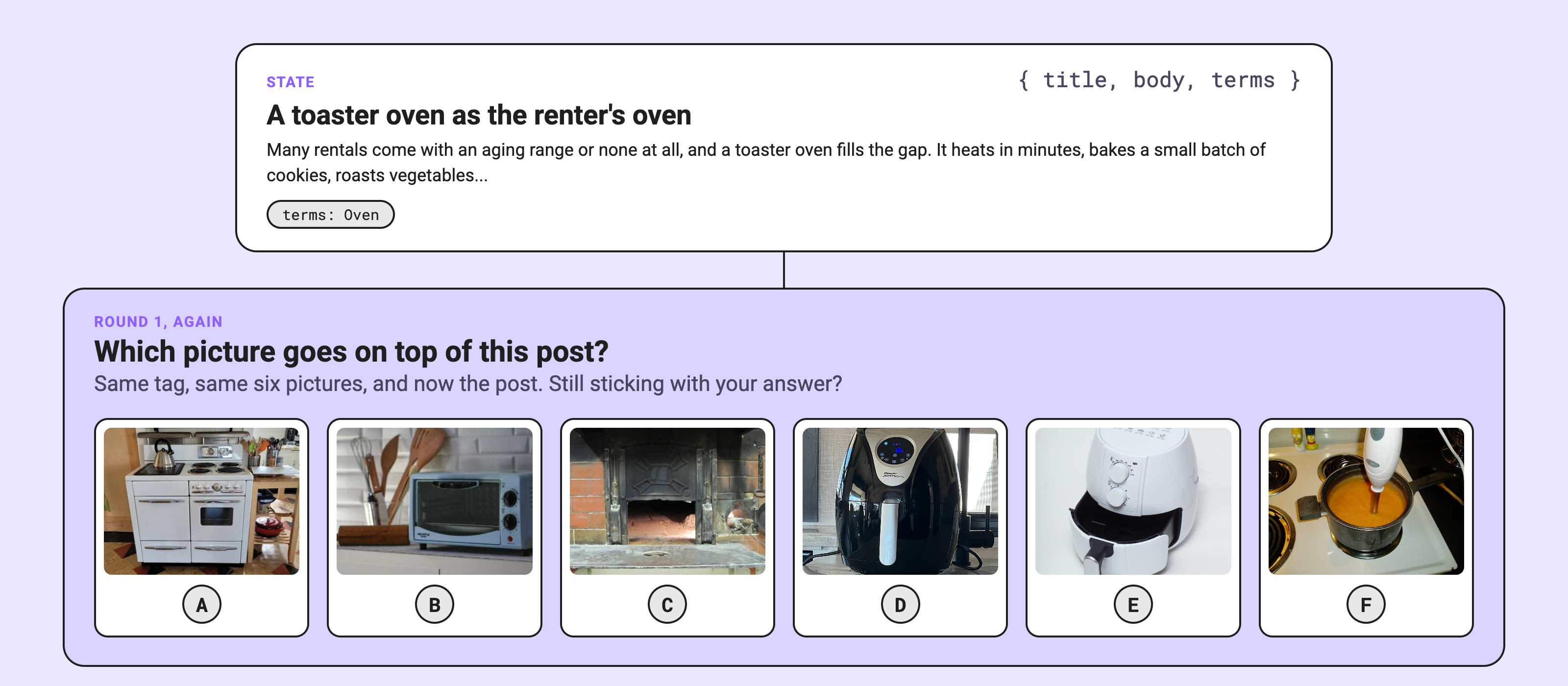
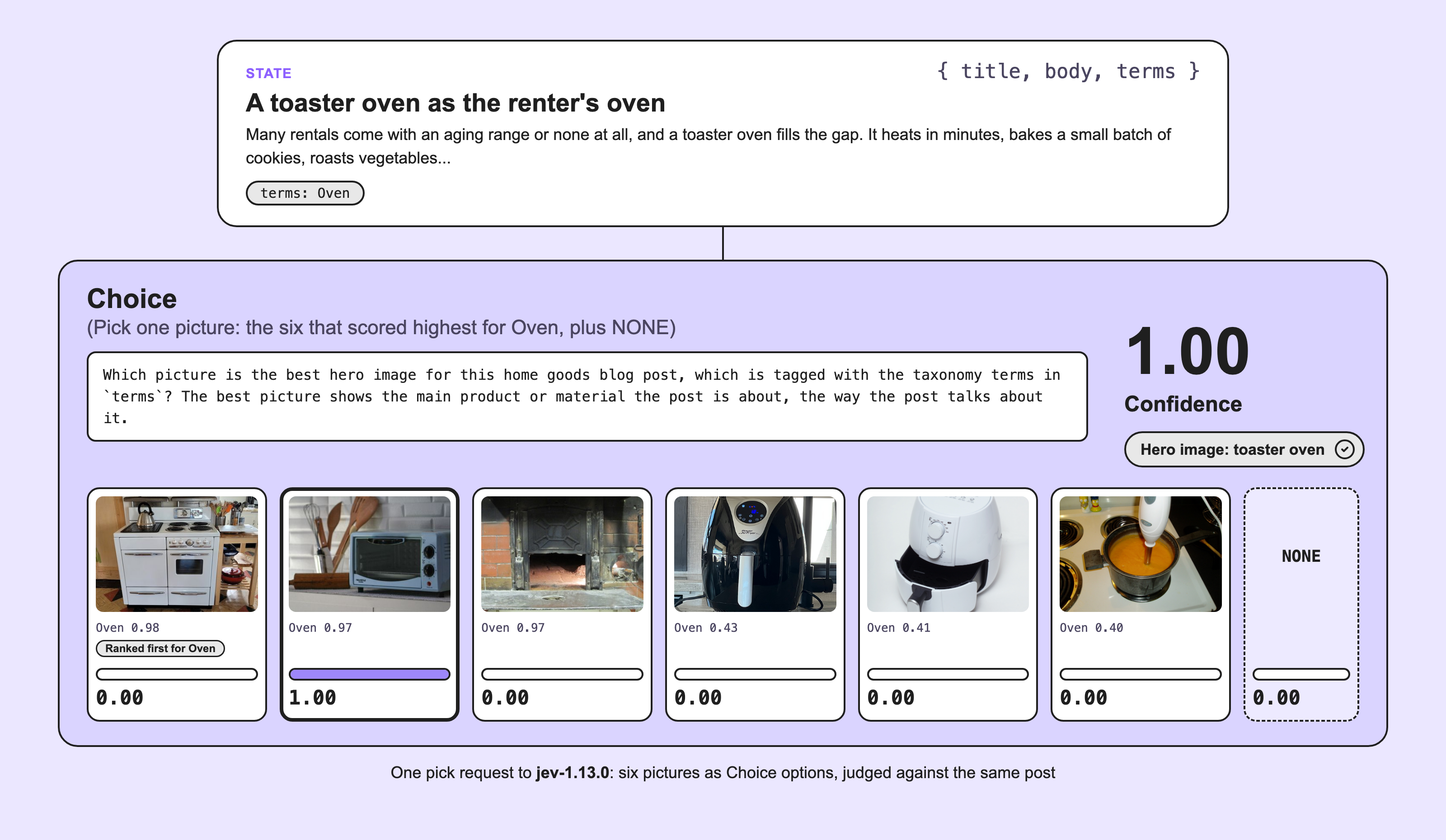
Still sticking with your answer? If you said A, the range stove, the first time and B, the toaster oven, now, congratulations: you just did exactly what Jev did. Let's go to the replay. The same pick request ran again with parts of the post removed:
State sent | Range stove | Toaster oven | Brick pizza oven |
|---|---|---|---|
| 0.70 | 0.18 | 0.10 |
| 0.00 | 1.00 | 0.00 |
| 0.00 | 1.00 | 0.00 |
With only the tag, Jev leaned toward the range stove, the same as the tag ranking. The title or the body alone moved all of the probability to the toaster oven. The tag ranking never gets that second try: it gave the range stove to all 12 toaster oven posts, and Jev's pick chose the toaster oven on 10. Here's Jev's answer from the run:
Round 2 answer: the dining table
Round 2, with the post. It's about a chair and a table together, so reading it doesn't change the answer. If you said A, the dining table, take the points. Jev put 0.96 on it:
Round 3 answer: the stockpot
Here's the line the edit added to the stockpot post: "If you make a lot of soup, an immersion blender lets you puree right in the pot without dirtying a second container." Everything else in the post is about choosing and caring for a stainless stockpot. Still going with A? Let's see the board:
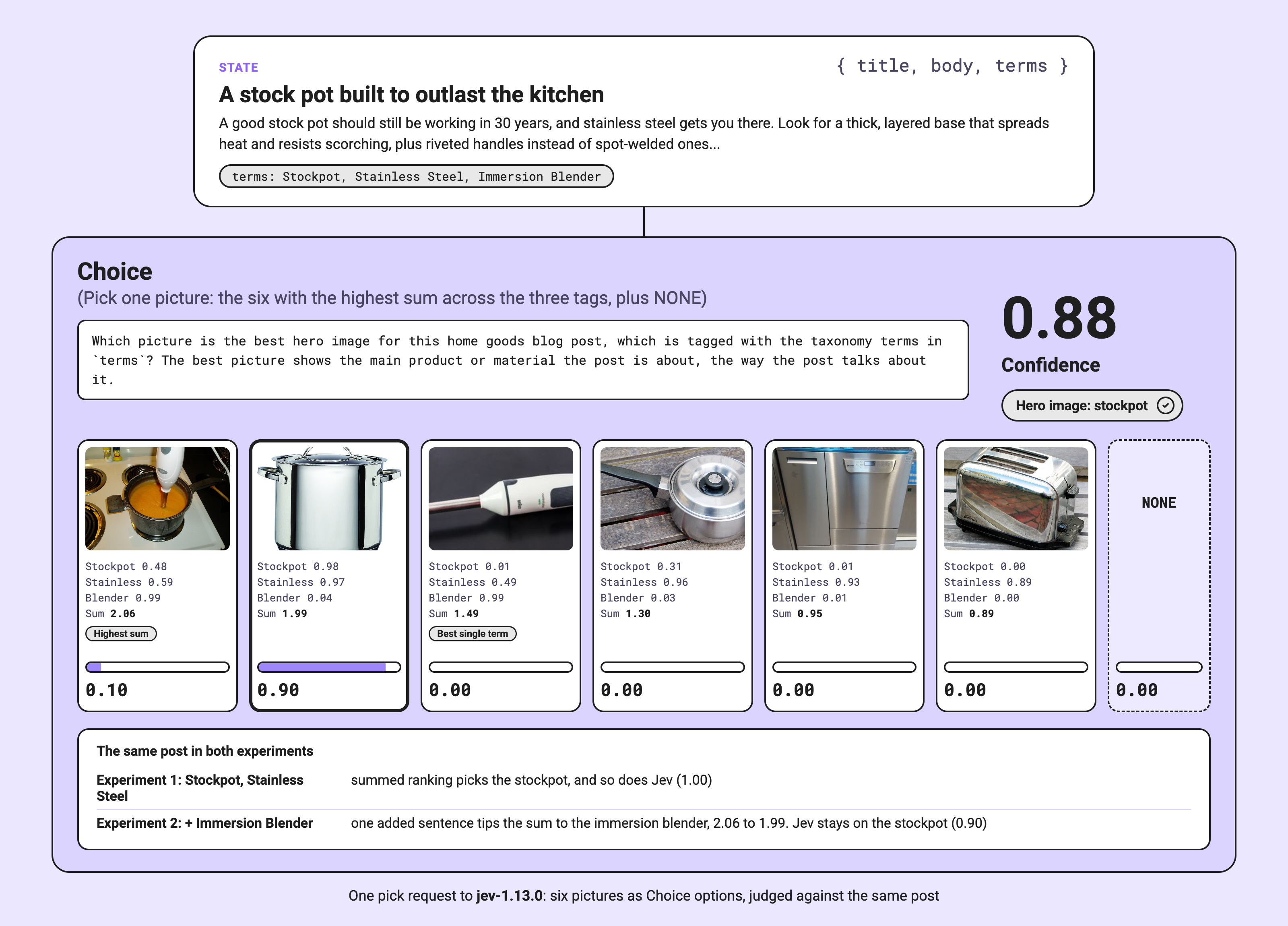
If you switched to B, the double points are yours. In experiment 1, with two tags, the summed ranking picked the stockpot too. One added sentence brought a third tag, and the immersion blender photo edged ahead, 2.06 to 1.99. Jev read the post and stayed on the stockpot.
The scoreboard
Let's check the scoreboard. Best available, by how many tags a post carries (for experiment 2, the terms the edit set out to add; the table skips its eight one-tag posts):
Tags on the post | Single best tag | Summed tags | Jev's pick |
|---|---|---|---|
1 (experiment 1, 1,234 posts) | 100% | 100% | 93.1% |
2 (experiment 2, 411 posts) | 79.3% | 78.6% | 84.7% |
3 (experiment 2, 1,243 posts) | 79.6% | 82.4% | 83.4% |
4 or more (experiment 2, 394 posts) | 61.7% | 72.3% | 75.9% |
More tags make it harder for everyone, Jev included. The tag math just falls faster. With one tag, summing is perfect, and Jev's pick trails mostly by choosing a close neighbor, like the duvet photo for 24 Bed Sheets posts. With two or more, Jev's pick leads at every tag count. Overall, the summed ranking went from 94.4% to 79.6% between the experiments, and Jev's pick went from 89.0% to 82.2%. By the looser measure, picking an image that shows at least one of the post's terms, Jev held steady at 90.8% and 90.2% while the summed ranking dropped from 96.8% to 89.4%.
Round 4: spot the impostor
Round 4, the lightning round. Remember the traps? Each group hides at least one impostor next to the real thing. Which one fooled Jev's index? Buzz in.
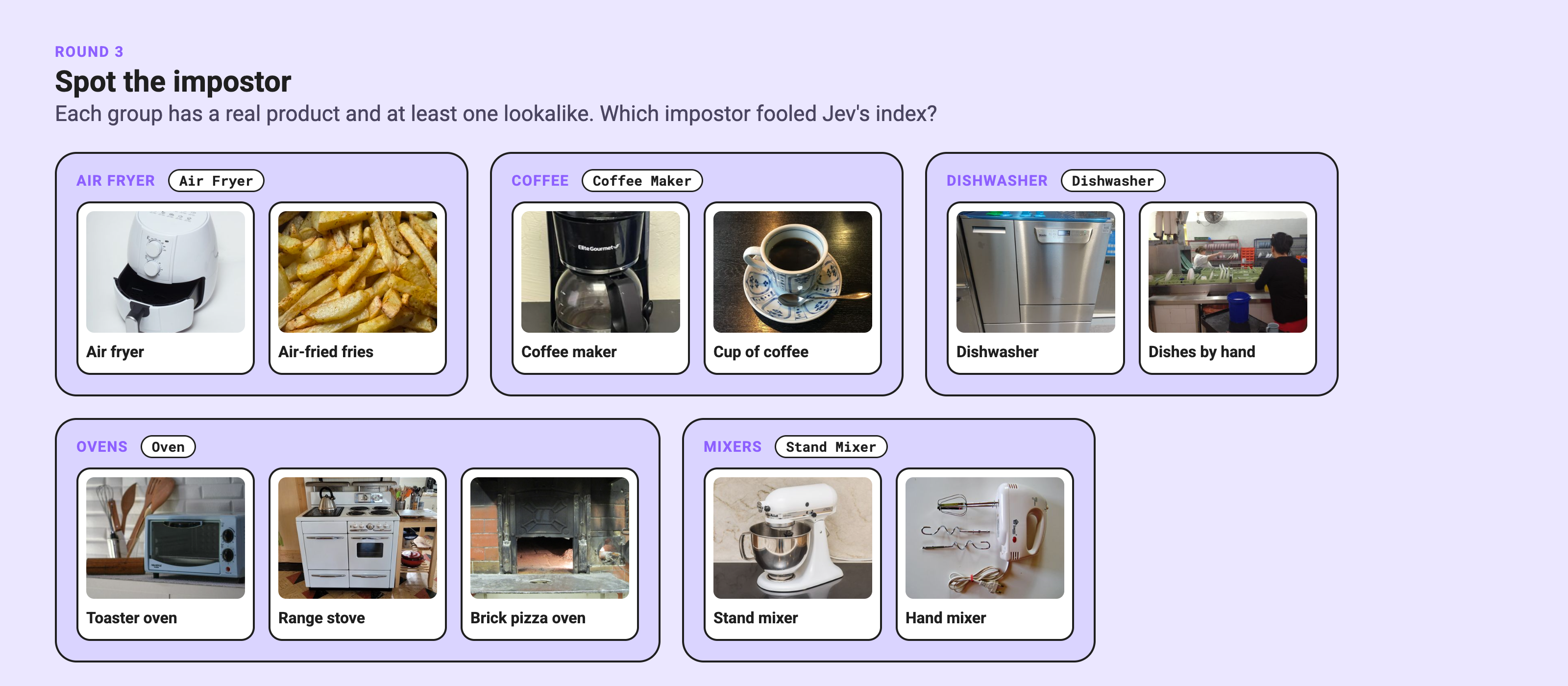
Ding ding ding: if you said the brick pizza oven, air fried fries, cup of coffee, and dishes by hand, take the points. Brick pizza oven scored 0.97 for Oven, and the summed ranking put it on one post in experiment 1 and nine in experiment 2. Jev's pick never chose it in either. The index caught the rest on its own: the hand mixer scored 0.10 for Stand Mixer, the cup of coffee 0.03 for Coffee Maker, and the fries 0.44 for Air Fryer against 0.99 for the air fryer itself (they looked delicious, just not like an air fryer). Neither method picked any of them.
Final round: is a low-confidence pick a wrong pick?
Final round, and you can wager everything you've got. Jev returns a confidence with every pick. When it drops below 0.5, is the pick wrong?
The answer: not always. When several pictures on a shortlist are right, Jev splits its probability between them, so the confidence in any one pick drops while the pick stays right. In experiment 1, 184 of the 237 low-confidence picks on posts with three or more right pictures were still right. Confidence still marks where the misses are: the 396 picks below 0.5, 19% of the posts, held half of the misses. It also tracks difficulty. Jev's average confidence fell from 0.79 on one-tag posts in experiment 1 to 0.63 on posts with four or more in experiment 2.
What it cost
Experiment 1 cost 75 cents: under three cents for the index (61 requests) and 72 cents for 2,056 picks, which ran in 2 minutes 34 seconds. Experiment 2 reused the index, so its 2,071 picks (Jev's new tags gave 15 untagged posts a term) were the only cost: 74 cents, in 2 minutes 10 seconds.
Takeaways
That's the show, folks. Here's what you take home for your own space:
- Index your images once. It took 61 requests and under three cents, and it caught most of the traps by itself.
- Sum the scores across a post's tags to build the shortlist. In experiment 1, summing found the best image on 82% of the posts where one image could cover several tags, against 41% for the single best tag, and the shortlist held a best-available image for every tagged post.
- Let the tag count decide who picks. For posts with one tag, the summed ranking alone is the stronger pick. Once posts carry two or more tags, let Jev read the post and choose from the shortlist.
- Send low-confidence picks to a person. They hold half the misses, and Jev's confidence drops as posts get harder.
Thanks for playing. Try out Taxonomies and Jev images for yourself!