CMS Migration Isn’t the Risk; Unplanned Migration Is

Storyblok is the first headless CMS that works for developers & marketers alike.
Some migrations are planned. Others are forced.
The forced ones rarely start with a single dramatic event. For many enterprise teams, it's a quiet accumulation: a security audit that flagged too many vulnerabilities to ignore, a licensing renewal that came back 40% higher, a competitor who launched three campaigns while they were still waiting on a developer to push a content update. Until one day it isn't quiet anymore when the legacy CMS fails during the year's biggest campaign.
However it arrived, the pressure is now real. Your team scrambles to evaluate alternatives, procurement gets involved mid-quarter, your developers are pulled off their roadmap, and you're making a six-figure infrastructure decision under pressure, on a deadline you didn't choose.
Now consider a different version of that same story. A year earlier, the same team flagged the same warning signals. They scoped a phased migration over two quarters, ran the new system in parallel, moved content in stages, and went live on a Tuesday with no fanfare. Same process but completely different experience.
This is the core truth about CMS migration that rarely gets said out loud: the process itself isn't what makes it risky. What makes it risky is doing it when you have no other choice.
The fear of migration is understandable. Enterprise content platforms carry years of integrations, custom configurations, and institutional knowledge. The idea of moving all of that feels enormous. But that fear has a cost. Every quarter spent on a system that's accumulating technical debt, thinning security support, and draining developer bandwidth is a quarter that narrows your options. And at some point, the choice stops being whether to migrate. It becomes under what conditions.
The organizations that come out ahead aren't the ones that avoided migration. They're the ones who decided to migrate before they had to.
Why unplanned migration is so much harder
Not all migrations happen in the same manner.
The forced migration happens under pressure. Someone or something made the decision for you, and now you're executing it in conditions you wouldn't have chosen. In practice, that looks like this:
- Content audits get skipped because there's no time
- Integrations get patched rather than properly rebuilt
- Training gets compressed into a single handover session
- The new system goes live before anyone is fully comfortable with it
- Budget gets allocated reactively, not strategically
The scars from that experience don't disappear once the migration is over. The workarounds, the technical debt, and the team frustration follow you into the new platform.
The planned migration is the same project, run differently. The content audit becomes an opportunity to clean up years of accumulated bloat. Integrations get rebuilt properly. Teams have time to get comfortable before going live. Budget is allocated based on scope, not urgency.
The main difference here is that the companies that describe migration as smooth just have more time to scope properly, phase carefully, and make decisions without pressure.
The hidden cost of staying on a legacy platform
Delaying migration can feel like the responsible choice: no disruption, no risk, no project to manage. But staying on a legacy system isn't a neutral decision. It's an active one, with a price that compounds quietly over time.
Security exposure that grows as your system ages
Legacy CMS platforms are monolithic by design, so when one part is compromised, the entire system is at risk. According to the State of Security 2026, 39% of enterprise teams experienced a security issue that directly impacted their content strategy in the last year, and the majority of those were running legacy systems. A further 17% are dealing with security incidents every single week. The older your system, the wider the attack surface, and the more engineering time goes toward keeping it patched rather than moving the business forward.
Developer time spent on maintenance instead of building
Tightly coupled architectures mean that even simple content changes often need developer involvement. But it's a recurring drain on your most expensive resource. Virgin Media O2 saved multimillions per year after migrating, in part because their teams stopped spending engineering cycles on system maintenance and started building instead. Meanwhile, TomTom improved content operations by 50% — not by hiring more people, but by removing the infrastructure friction that was slowing them down.
Opportunity cost that never shows up on an invoice
The campaigns you couldn't launch in time. The personalization you couldn't deliver. The markets you couldn't enter because the system couldn't support it. These losses are real, but they're invisible, which makes them easy to ignore until the gap between you and your competitors becomes impossible to close.
The cost of staying shows up in sprint velocity, in security audits, in hiring difficulty, and in the things your team simply couldn't do last year. The longer you stay, the more normal it feels and the harder it becomes to see what you're actually paying.
Where do you stand? The migration readiness spectrum
Most enterprise teams aren't at either extreme. They're somewhere in the middle: aware that a migration is coming, but not yet treating it as a priority. Understanding where you sit changes what you should do next.
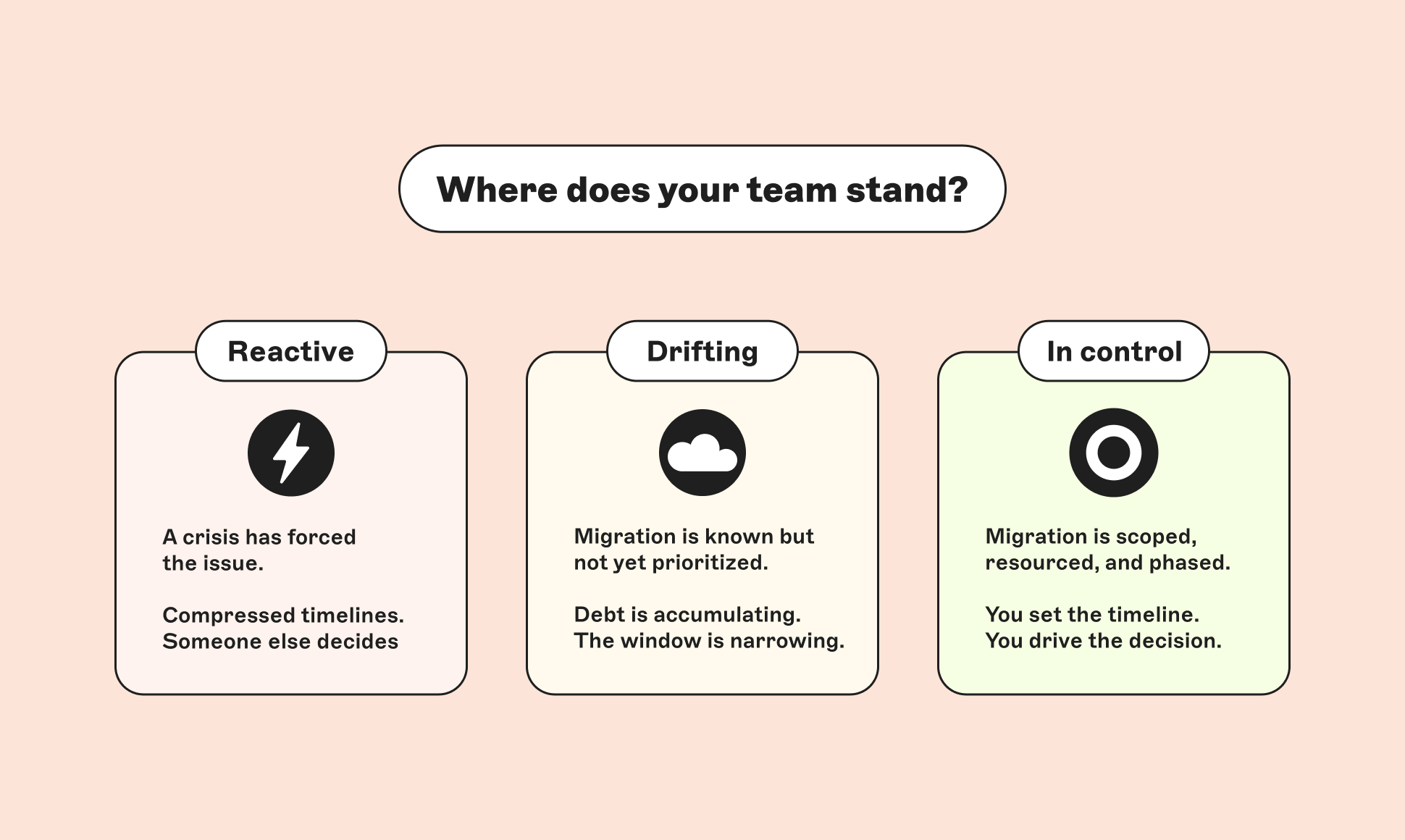
In control. You're planning migration on your terms. The project is scoped, resourced, and phased. Your team is making deliberate decisions about timeline and approach, and the business is driving the change rather than reacting to it.
Drifting. You know migration is inevitable, but it hasn't been prioritized. Technical debt is accumulating, security complexity is growing, and the window to migrate on your own terms is narrowing, even if it doesn't feel urgent yet. Most enterprise teams reading this are here.
Reactive. A crisis, a vendor decision, or an internal breaking point has already forced the issue. You're migrating under pressure, with compressed timelines and limited room to do it well.
Our goal here isn't to alarm. Most teams in the drifting category still have time to move into the "in control" position, but that window doesn't stay open indefinitely. Unfortunately, legacy systems don't announce when they're about to become a problem. However, the signal is usually only obvious in hindsight.
The question worth asking isn't "should we migrate?" It's "are we still the ones deciding when?"
What a smooth migration actually looks like for enterprise teams
The most common misconception about CMS migration is that it's a single event: a cutover date, a big launch, a moment where everything switches from old to new. But in practice, the migrations that go well look nothing like that.
A well-planned migration is a series of deliberate phases, each one lower-risk than the last because you've already learned from the one before it. And for enterprise teams, the structure is even more important than the system's scale.
1. It starts with a content audit, not a content move
Before anything migrates, you need to understand what you actually have. What content is still live and relevant, what's been orphaned, what integrations are load-bearing, and what can be retired entirely. This is the work that gets skipped in reactive migrations, and that teams consistently say they wish they'd done properly. For large enterprises, it's also an opportunity: years of accumulated content can be cleaned up, consolidated, and restructured before it ever touches the new system.
2. The old system stays live while the new one is built
Running both systems in parallel removes the pressure of a hard deadline. Content teams can be onboarded gradually, using the review of migrated content as hands-on training in the new environment. Editors get comfortable before the new system is their only option. Developers can test integrations without consequence. When the new system is ready, the transition happens because it's earned, not because a calendar forced it.
3. Content moves in phases, not all at once
Lower-stakes content migrates first. You learn from it, fix what needs fixing, and scale up with confidence. By the time business-critical content moves, the process is well understood, and the risk is genuinely low. For enterprise teams managing multiple brands or markets, this phased approach has an additional benefit: the first migration becomes a repeatable playbook. The second site, region, or brand moves faster because the framework already exists.
4. The plan includes a rollback option
A good migration plan accounts for the possibility that something doesn't go as expected. This isn't pessimism but more of an engineering discipline. Teams that have a rollback plan rarely need it. Teams that don't are the ones who end up in the case studies nobody wants to be in.
It's worth noting that the friction of legacy systems isn't just an operational problem: 67.5% of senior developers say their CMS holds them back from doing their best work, with almost half describing it as a constant hindrance. A structured migration addresses that directly, giving teams the infrastructure to move faster without the workarounds that slow them down.
This is what Virgin Media O2 experienced when they migrated to Storyblok, saving multimillions per year in operational costs. It's what TomTom found when they cut content operations time by 50%. Neither of those outcomes came from a rushed migration. They came from a structured one.
The best time to plan a migration is before you have to
Some migrations are remembered as turning points. The moment a team finally got the infrastructure they needed to move faster, ship better, and stop spending engineering cycles on maintenance. Others are remembered as the hardest thing the team ever had to do, not because migration is inherently difficult, but because it happened under pressure, on someone else's timeline, with no room to do it properly.
Our message is simple: migration isn't the risk, but an unplanned one is. And the antidote to unplanned migration is exactly what it sounds like: a plan. Start planning now.