The Wexl Arena is a family fun park located in St. Corona, Lower Austria. The project goal was a complete redesign and relaunch of the two websites.
Hospitality
JoyConf 2026 is back. Content Confidence. Human Connection. Save your spot!

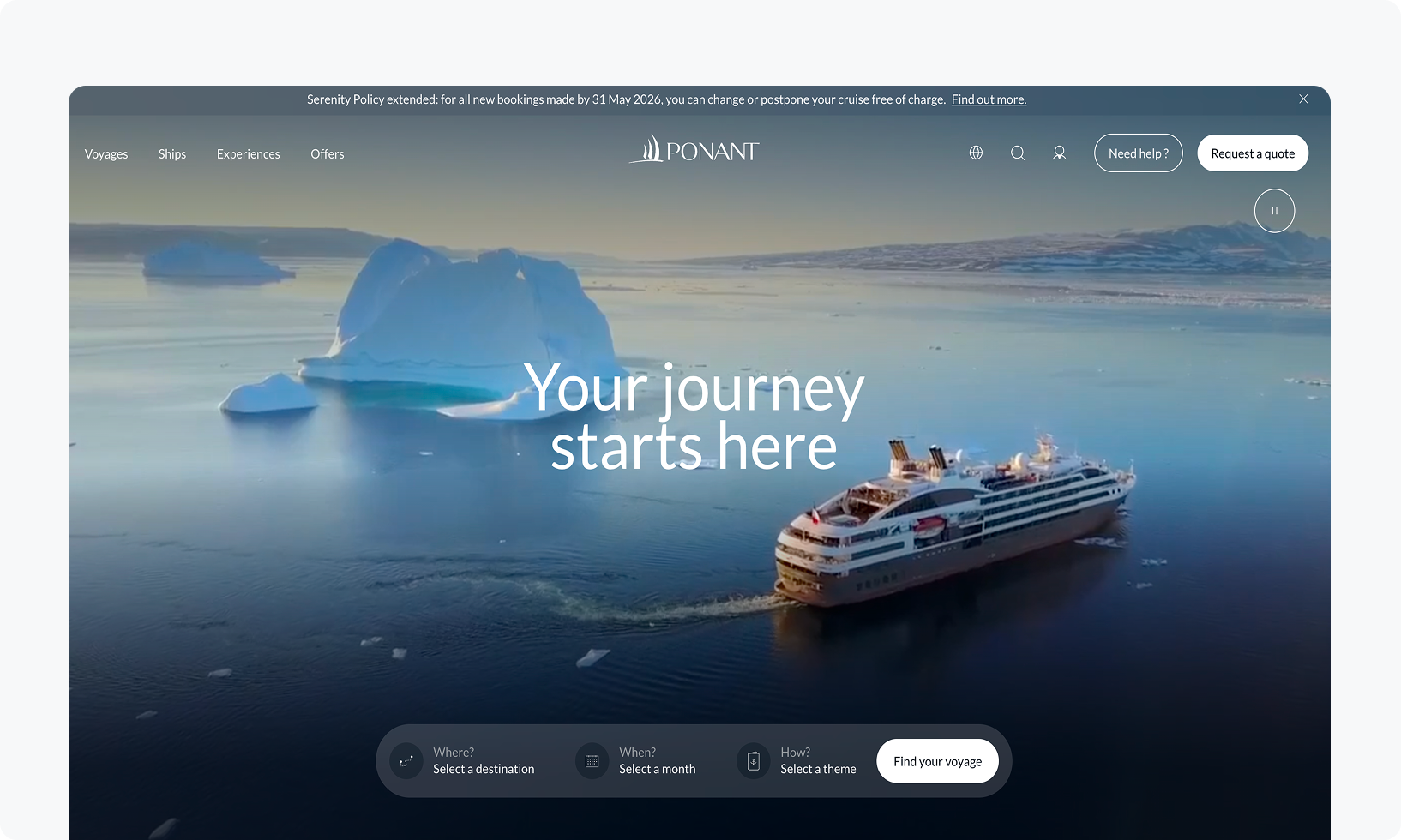
For Ponant, a world leader in luxury expedition cruising, the expectation of quality goes beyond the voyages themselves — it spans the entire customer journey. From exploring remote destinations in the heart of the Amazon or the Poles, to savoring the elegance of five-star French hospitality onboard, to a customer’s first digital encounter with the brand — every touchpoint is designed to feel exceptional.
As Ponant continued to expand globally, the team realized delivering digital experiences that matched the luxury of its onboard experiences would require a content ecosystem that could adapt and scale with the business. Marketers needed greater autonomy, developers needed a more modern, flexible architecture, and the organization needed a central content platform capable of supporting fast, consistent delivery across markets.
The team was in search of a tech stack that could support their goals from the inside out, and they set their sails towards a more composable content future. One that would transform how its team creates, manages, and delivers content globally — with the support and expertise of its implementation partner, AKQA.
Ponant’s setup with Magento 2 for the frontend and backend, and WordPress for the CMS, added more complexity and cost than value.
The WordPress–Magento integration (via FishPig) tightly coupled content to the frontend, so most updates had to be coded rather than edited visually. External partners handled the majority of updates, while internal developers maintained the connector, managed upgrades, and oversaw infrastructure — a setup too heavy to keep pace with Ponant’s digital ambitions.
It was time for Ponant to chart a new course towards a modern, flexible content ecosystem that enhanced cost and team efficiency, reduced developer dependency, and unlocked scalability and speed-to-market for the future. Starting with clear criteria of what their new setup had to deliver:
We approached this as a product transformation as much as a technical one, structuring content into reusable components and empowering teams to operate more autonomously across markets.

The procurement and evaluation process to find a CMS that checked all their boxes took about three months, during which the Ponant team tested editorial workflows, component modeling, localization, and ease of use with multiple providers, including Contentful, Prismic, Strapi, and several other e-commerce-oriented platforms — before finally selecting Storyblok as the CMS for the job.
From testing out a range of CMS solutions, here’s what made Storyblok stand out:
With support from their external partner, Ponant migrated to Storyblok using a step-by-step, product-led rollout. The process began with building a robust component library and governance model to lay the right foundations, followed by hands-on editor workshops to onboard teams effectively.
What stood out with Storyblok wasn't just the platform, it was the partnership. Their team worked hand in hand with AKQA and Ponant from day one, with a level of proactiveness and team spirit that made the entire migration feel like a shared mission rather than a vendor relationship.

Today, Ponant’s digital product managers, editors, marketing owners, external partners, and frontend tech team all actively collaborate in Storyblok in parallel, streamlining workflows and ensuring faster, coordinated delivery across the board.
Ponant also continued building out their flexible, modern tech stack to support their digital goals, fully integrated with Storyblok, featuring:
We implemented a dedicated ExpressJS server leveraging Storyblok’s Management API to automate data imports. Daily (or following a manual prompt), this server pulls data from our various internal endpoints and creates or updates stories in Storyblok. This enables painless data updates for most of our catalog.

After moving away from monolithic architecture and adopting Storyblok, Ponant saw significant improvements in content operations, speed, and team autonomy, enabling the brand to deliver a digital experience that matches the luxury of its expeditions.
In particular, up to 7x faster content operations and delivery, as teams have the freedom to move faster and the tech to easily deliver across channels and the world. This has enabled marketing to manage 80% of all content independently and publish it across every region and channel from a centralized content hub — no developer intervention needed. Overall, they’ve transformed their digital agility, as teams across the business can iterate, create, and deploy quickly without compromising quality or consistency through modular, headless architecture — delivering the composable content system they set out to find.
Moving from a WordPress setup to Storyblok reduced content time-to-market from days or weeks to hours and shifted the vast majority of editable pages and content updates (around 80%) to editorial and marketing teams. Developer dependency is now limited to component and module evolution, while content publishing, localization, and campaign launches are now much more autonomous and decoupled from code releases.