
Read our insurance case study on Prighter's journey to a future-forward headless CMS built with Storyblok.
Insurance
JoyConf 2026 is back. Content Confidence. Human Connection. Save your spot!

Pax is a Swiss insurance cooperative at the heart of the country's pension system, offering tailored solutions for private and occupational retirement planning. Its mission is to make retirement planning simple while creating long-term value for its members, who share in the company's financial success. With a strong focus on responsible business practices and long-term relationships, Pax has built a reputation for trust and reliability.
Its website, pax.ch (opens in a new window), serves three distinct audiences: individuals planning their personal pension, companies setting up employee pension plans, and a nationwide network of distribution partners. It's a site where trust and clarity aren't optional extras. They're core to what the brand delivers.
For years, that site ran on a monolithic, on-premise CMS tightly coupled to the frontend, with no shared design system or component library to speak of. It worked. Until, gradually, it didn't.
No single incident triggered the rethink. Instead, a cluster of structural problems had been quietly compounding.
The CMS was reaching end-of-life, forcing a decision that couldn't be deferred any longer. The editing experience was slow and unintuitive—far removed from how modern content teams expect to work. The platform ran on a separate technology stack that sat outside Pax's broader IT landscape, making cross-team knowledge sharing and tooling alignment harder than it should have been.
But the most important aspect was ownership. Over time, key parts of the solution such as the codebase, operational knowledge, and day-to-day control had come to sit largely with an external agency rather than within Pax. While this model had served its purpose, it also made it harder for Pax to move independently: to ship faster, experiment more freely, and adapt the platform in line with its own priorities.
A like-for-like upgrade would have addressed the end-of-life problem, but it wouldn't have solved the rest. So instead, Pax defined four goals for what a proper reset needed to achieve:
Pax evaluated a broad field before arriving at a shortlist of three: Storyblok, Strapi, and DatoCMS. The decision came down to a combination of editorial experience, developer confidence, and strategic fit.
Storyblok's Visual Editor (opens in a new window) stood out for non-technical editors. The component-based content model suited the way Pax wanted to structure and evolve the site. Native multi-language support handled DE/FR/IT without friction. And critically, youEngineering (opens in a new window), Pax's implementation partner, had direct hands-on experience with Storyblok from previous projects, which meant the technical evaluation wasn't just theoretical.
The SaaS model aligned with Pax's strategic shift away from on-premise.

Pax UI Library
The team was small by design. On the Pax side: Project Management, Business Engineering, and Solution Architecture. youEngineering brought a lead developer/architect and two engineers. Everyone involved was senior, with prior experience working in or alongside engineering teams. This combination kept decision-making fast and the structure lean, which turned out to matter a great deal, given the timeline.
The implementation covered 150 pages in three languages, approximately 1,000 documents and assets, and 10 content types, all within a single Storyblok space. The migration kept the existing content structure largely intact, which reduced the scope of editorial rework and allowed the team to focus effort where it counted.
By the time launch day arrived, there was little left to do. Everything had been built and tested before cutover, parallel running was kept to a minimum, and the switch came down to a DNS change. On the editorial side, onboarding was equally smooth: real-time preview meant editors saw their changes instantly, and components were built with guardrails so the team could move confidently within a well-defined structure from day one.

Pax Website Sitemap
Under the hood, the pipeline runs on GitHub and Argo CD. Choosing Static Site Generation for production meant Storyblok only enters the picture at build time. This deliberate trade-off pays out in performance, security, and a setup that reduces runtime dependency on external systems. Editors, meanwhile, get a server-side rendered preview environment so changes show up instantly. Webhooks keep Storyblok and the build pipeline in sync, while scoped Personal Access Tokens add an extra layer of security to the setup.
The frontend is hosted on Pax's own infrastructure. Assets are served via Storyblok's CDN, and Storyblok's Image Service handles optimization and transformation, cropping, and modern format delivery, which was a new capability for the team and has proven genuinely useful in practice. Storyblok also serves as the central repository for all of Pax's public assets: brochures, PDFs, and documents.
On the package side, the team uses the official @storyblok/astro SDK alongside @storyblok/richtext for content rendering.
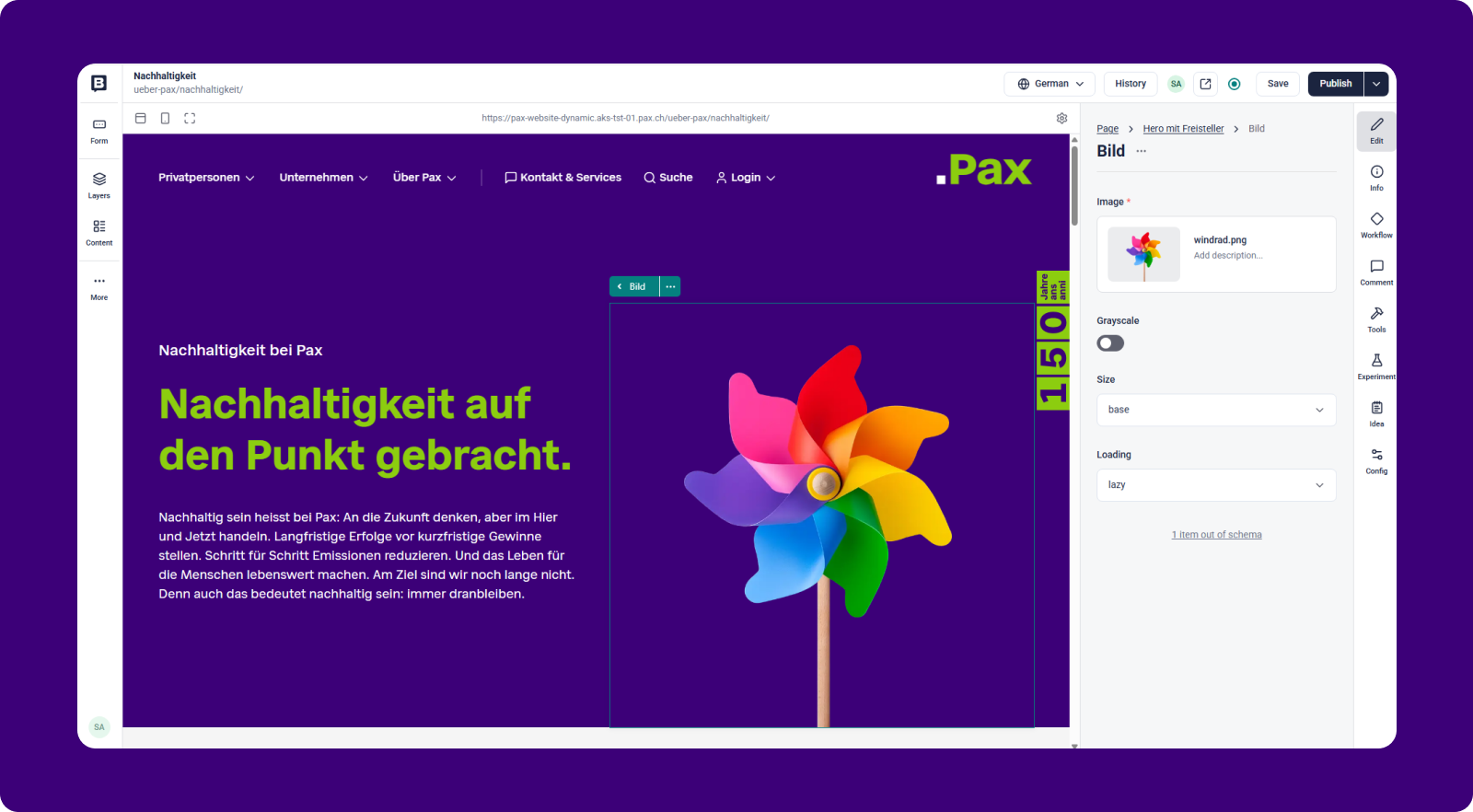
Real-time preview meant editors saw their changes instantly, and components were built with guardrails
Four months for a 150-page, trilingual site migration and a complete technology rethink.

With ownership of their digital presence firmly in-house, Pax is already pushing further: A/B testing, new editorial workflows, and an expanding role for Storyblok as new use cases emerge, including a closed user group portal.
None of it would have moved this fast without the right partnership. Pax and youEngineering were aligned from day one: outcome-driven, light on process, and built on mutual trust.
A monolith that had held Pax back for years was replaced in four months. That's what happens when the right team, the right tools, and the right mindset all arrive at the same table.