Read our telecommunications case study on Firsty's journey to a future-forward headless CMS built with Storyblok.
Telecommunications
Your content estate could be your biggest revenue liability. Find out why — Join us live on Sept 22

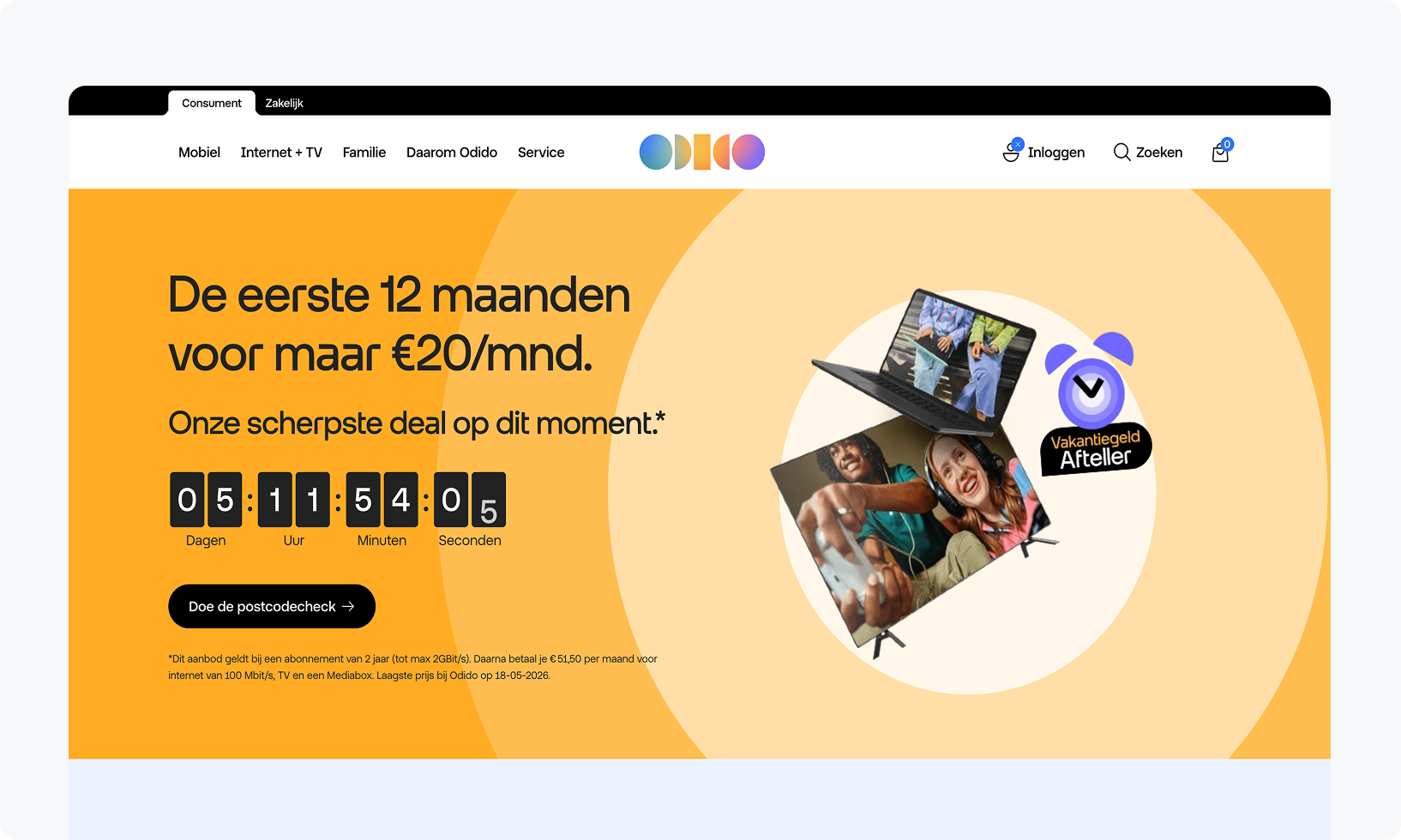
Hello, you’ve reached Odido.
Press 1 to hear how we revolutionized content operations.
Press 2 to skip straight to the impressive results.
Press 3 to hear this success story read in a robot voice.
This is the part where we’d usually put you on hold... But instead, let us show you how we picked up the call and dialed into something game-changing.
Your phone does a lot in a day — from waking you up to distracting you from work to ordering sushi at 11 pm. But none of it works without a rock-solid connection. And in one of the most connected countries in the world, that signal comes from Odido.
Odido (opens in a new window) is the largest mobile telecom provider in the country, keeping over 8 million customers connected — nearly half the population of the Netherlands. Through brands like Odido, Ben, and Simpel, they offer everything from mobile and fiber internet to TV and wholesale business services. Plus a few clever extras, like SimWallet, their on-demand 5G internet access service.
With 120+ stores across the country and more than 2,000 employees, Odido has national reach, but its real strength lies behind the screens. It builds fast, scales smart, and does almost everything in-house. Its full-time content team and internal development partners manage everything from daily page updates to deep system integrations.
Their audience? A mix of consumers and businesses, with mobile and fixed-line households making up the largest slice. In short, they’re not just keeping the Netherlands online — they’re constantly raising the bar for how it’s done.
And with Storyblok, they’ve raised it even higher, cutting publishing times by more than half and flawlessly rolling out an entirely new brand overnight. So how did Odido go from a legacy CMS behemoth to one of the fastest, most resilient content operations in telecom? Let’s rewind.
Before Storyblok, Odido’s content operations were running on… let’s call it a legacy setup with too many miles on the dial.
For over 20 years, a traditional enterprise CMS sat at the heart of their content ecosystem. It was file-based, FTP-deployed, and deeply embedded in workflows that no longer matched the speed or flexibility the business needed. Think web forms, shared drives, and manual versioning. Editors weren’t editing — they were assembling. And developers were stuck playing catch-up across environments.
The team structure itself was solid:
But the system behind it all created friction that no process could fix.
A typical page involved:
The CMS wasn’t the only problem. The bigger issue was the way teams had to work around it. Editors lived in production. Developers worked in non-prod. Both were creating and shaping content in separate silos, and when everything finally had to be merged, content went missing, versions clashed, and launches stalled.
The architecture was outdated, the learning curve for editors was steep, and every workflow dragged on longer than it should. Frustration spread across teams as the gap widened between what the business needed and what the CMS could actually deliver.
There was no dramatic crash. A slow, grinding build-up of friction turned publishing into an exercise in patience. Editors tiptoed through outdated structures while developers patched problems they knew wouldn’t exist in a modern setup.
The next CMS had to be fast. It had to be modern. And it had to be built for collaboration, not just contribution. The only question was: did it actually exist?
Odido didn’t jump on the first shiny CMS they saw. The search took four months of research, comparisons, and internal debates. A shortlist of contenders was invited to pitch, and every stakeholder — editors, developers, architects, business leads — got a vote.
The non-negotiables were clear:
Several platforms ticked the technical boxes. But Storyblok stood out where it mattered most: the editors loved it. For the first time in years, the people who actually created content were excited about the tool they’d be using every day.
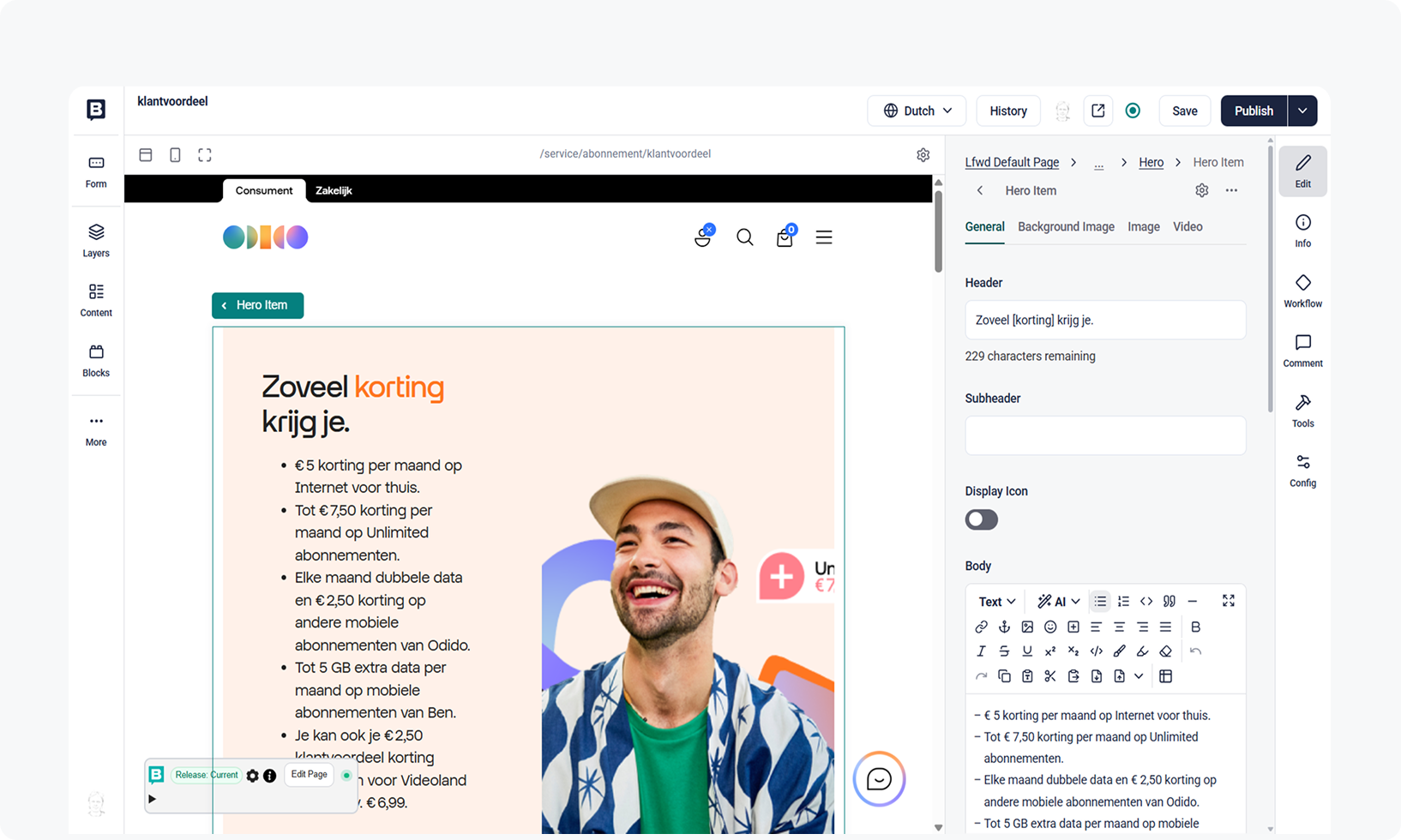
Odido's visual editing experience in Storyblok
Adoption wasn’t forced — it was embraced. Editors could finally imagine a system that supported the way they worked instead of slowing them down. Developers saw the same opportunity to rebuild processes on solid ground.
That mix of editorial excitement and engineering confidence gave the project momentum.
Midway through the rollout, the project took on a new layer of complexity. At that point, Odido wasn’t even Odido yet. It was still T-Mobile Netherlands. (Plot twist, right?) Behind closed doors, however, the company was preparing for one of the biggest shifts in its history: a complete rebrand and a new digital identity.
It was a moment designed to redefine the company, not just rename it. The new Odido brand had to launch seamlessly across thousands of pages, a redesigned website, and a fresh digital experience with no margin for error. Multiple teams of editors and developers worked in parallel, migrating content, building new structures, and creating an entirely new design system envisioned by the UX department — all while keeping the old T-Mobile site live and stable until the big day.
Rebrands are rarely smooth. But when launch day came, Odido’s new identity went live seamlessly. Days later, the company ran one of its biggest annual sales events just as smoothly.
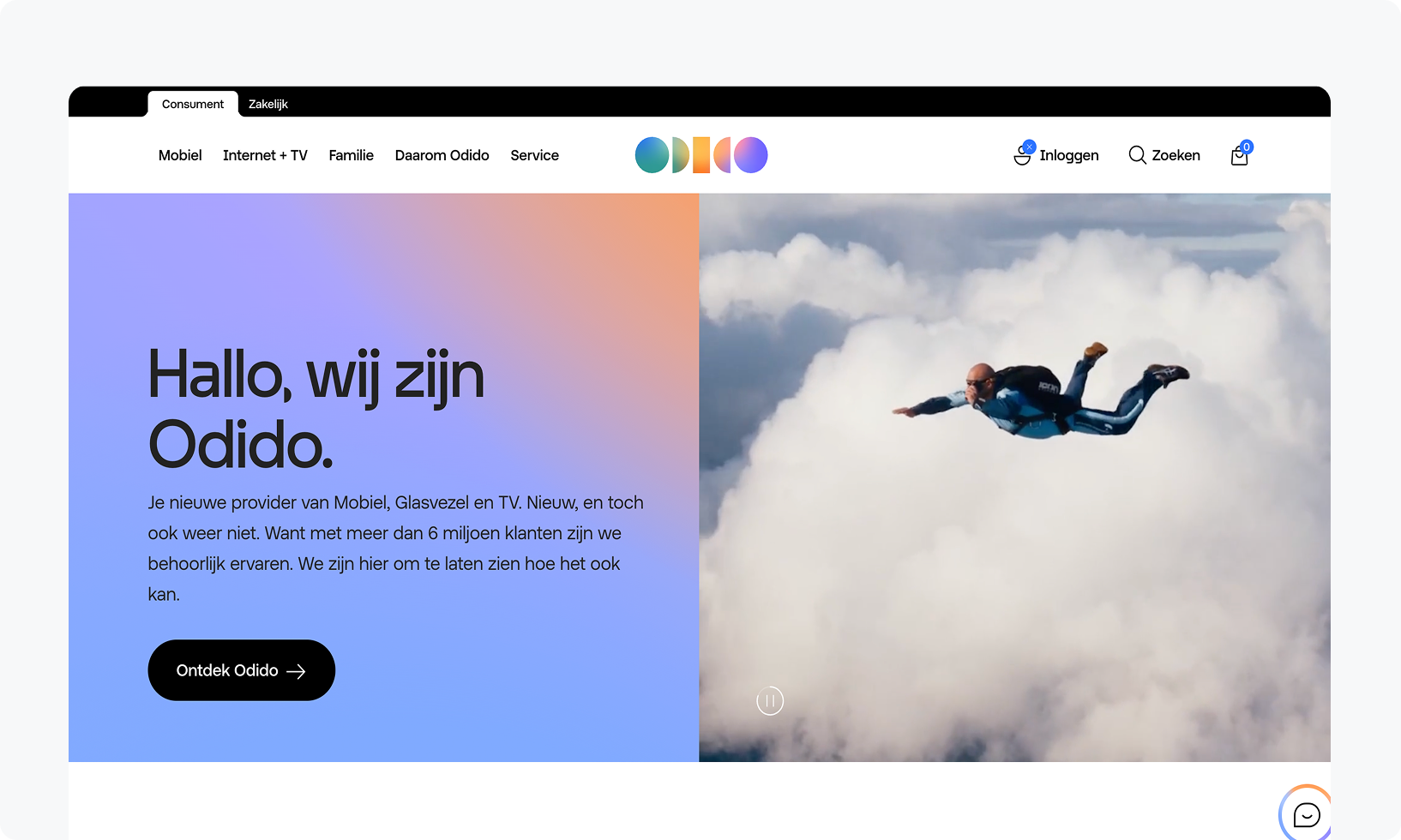
A page from Odido's rebranded website
With Storyblok, Odido pulled off its rebrand at full scale, under pressure, and without a second of downtime. What could have been chaos became the ultimate stress test and a showcase of stability at scale.
For developers, Storyblok’s headless setup replaced file-based bottlenecks with a modern, API-first architecture. Work that used to mean endless fixes and fragile merges now scales cleanly across websites, apps, and internal tools.
Editors, meanwhile, can publish at speed, without waiting on developer support. What used to take days now takes hours — sometimes minutes. For the first time, both groups are working in sync instead of in silos, and that collaboration has reshaped how content gets made at Odido.
The impact shows up in the numbers:
The change goes deeper than faster publishing or better architecture. Storyblok gave Odido a platform their people actually enjoy using. It speeds up work without slowing down creativity and will keep evolving with them as their needs grow.
Odido is built to keep millions connected. And with Storyblok, their content operations now have the same full bars: fast, dependable, and future-ready. It’s the kind of foundation that turns big shifts, like a rebrand, into business as usual.